Last weekend Michele and I met up with our friend Roz to check out some of the work showing over in Culver City. A bunch of spaces were open late Saturday in concert with the LA Contemporary Art Fair across town in the Pacific Design Center. We managed to find some great stuff here and there, like the above neon wall piece, ChakrAK-47 by Artemio at LAXART.
At Honor Fraser we were confronted with Gustavo Godoy’s Fast-Formal Object: Big White. The installation is a seemingly random construction of various lumber, dowels, stamped sheet materials and concrete, painted white with its own lights built into it. It reads as a playful study of form, light and shadow, very architectural but also very drawing based, as many of the elements read like various line strokes. With a small platform inside and ramp leading it, it also gives off a constructivist playhouse vibe that keeps the whole thing from getting too serious. We stuck around for a gallery talk on this one, but I found I liked the work much better before I heard the artist talk about it.
Also at Honor Fraser was a projected video piece by Fabien Giraud and Raphael Siboni in which teams of armed combatants battled among a landscape of movable black objects (much like large pedestals or gallery dividers) and theatrical smoke. The groups, costumed as a military contingent, prisoners in orange jumpsuits, civilians, rap-gangstas, and zombies (?) in medical garb (am I missing any? perhaps there were some terrorists too?) played like video game characters brought to life. They ran towards each other across the space, clicking paint ball guns at each other (no added sound effects) and dying by the dozens. Each shot was a continuous tracking shot across the space, gliding smoothly by on rails, starting from the right hand side every time as the groups went through their maneuvers. This one is part of Lab’s inaugural exhibition VideoRoam, a series curated by Paul Young. Lab is a sort of side project of Honor Fraser, “a forum for the explorations of the arts community in and outside of the Los Angeles area beyond the existing gallery program”.
Finally, down at Angles Gallery, among paintings I didn’t care for at all, we found this little gem of a wall sculpture by Tom LaDuke – a delicate little bit of twig somehow mirrored as if hanging above the surface of a still pond. Around the corner from this, a vertically oriented video proved to be the highlight of our tour. In crisp HD, a still life with hanging bird, grapes, water and plaster wall turns out to be a super-slow-motion shot of the bird simply dropping into the water below. The details of the feathers, the water splashing out into droplets, the sheen of the grapes, recalled old master’s still life painting – and more recently Bill Violas interpretations of the master’s at his Getty residency – but still managed to stay in itself a captivating work.
(hm. I didn’t write down the name of the video artist and now I can’t find it on their website.. same for the above projection. What is it with galleries snubbing the video artists on their websites? Unless I am just missing something)
“The MexiCali Biennial is a non-profit organization that aims to provide a platform for border crossing, progressive art exhibitions and events. These interventions, installations and performances encourage dynamic cultural exchanges that resonate within the fluid context of the territory covering Mexico and California. Concentrating on the border as the site of transgressions, this biennial distinguishes itself by tapping into a unique aesthetic derived from a culture of art and critical dialog evolving from the confluence of both countries in a region defined by its hybridism.
The first MexiCali Biennial took place in Mexicali in 2006 with the idea of producing an exhibition featuring artists from California and Mexico. The addendum of “Biennial” was a deliberate political choice—to add to an art show in Mexicali a term that came with the baggage of art-world prestige and exhaustion, a Biennial at a time when no one could stand the thought of another one. The aim was to provide artists with an opportunity to respond and transgress the overarching environmental context of the production and display of their work with a notion of conversation that engages both with the heavily funded and institutionalized Biennial framework and the less formal and often more innovative process of bi-national exchange that happens every day.”
Lately I have been experimenting with a slew of different audio tools, both hardware and software – analogue and digital. Eventually the ideas and methods will work their way into this project, Matter Management‘s Vivarium, which I am doing sound design for. It will be constructed, birthed, and will die in the Sci-Arc Gallery, and is the creation of MM’s CEO Juan Azulay. The sound portion of the Vivarium takes on the identity of a sort of organic and machine hybrid synthesizer with many layers of interactivity.
This little test is a tongue-in-cheek software and MIDI input test (using a simple controller to alter several different parameters in how the sounds are shaped or generated) using the 80’s ballad The Captain of Her Heart by Double, a variable sine wave, and an ethereal audio track of my creation as its main audio inputs. Later on the controllers will all be sensors, and the sound will be – shall we say more brooding and insectile? The video up there was created using Akira Rabelais‘ intriguing software, Argeïphontes Lyre, which I have also been messing around with lately. Its rather difficult to get something intentional out of it (for me), but quite easy to find pleasant surprises when you just let it go ahead and do what it does (which, incidentally, is not actually obvious on the first, second or sometimes third tries).
If you’d like to participate, please let us know any of the following:
1. What do you think (or hope, or fear) you will personally be doing in the future? And when you think it will happen by? (Will you buy a condo in Union Square in 2043? Will you have twins in 2011? Will your unborn child become a famous pianist in 2074?)
2. What you think (or hope, or fear) Somerville will be like in the future? (Will there be hi-rise apartment buildings in Davis Square by 2047? Will the plague strike? Will your neighborhood be gentrified? When?)
Tell us a story! Draw us a picture! Make us a map!
All participants will receive full credit for their images, concepts, stories, and data.
We can be reached at future.of.somerville@gmail.com . We hope to hear from you!
—
All predictions received by December 31, 2009 will be included on our website, and in our printed timeline. Everyone who makes a prediction will get a copy of the timeline.
This project is organized by Tim Devin, and is sponsored in part by the Somerville Arts Council.
The weekend before Thanksgiving Michele and I went over to one of the old hangars by the Santa Monica Airport to check out the show Cautionary Tales, Feral Structures at Arena 1 gallery. Curated by Berenika Boberksa and presented in several rooms underneath the cavernous roof of the hangar building, the show consisted of works by artists and architects from London and Los Angeles. Each piece employs the cautionary tale as a narrative device which plays out in the feral structures created or proposed in the space.
Our invitation to attend a small gallery talk turned out to be an invitation to participate in a small panel giving the gallery talk… and when we finally got our bearings the conversion kept cycling around the differences between the architects and the artists, and methods each group might employ when working within a gallery context.
As we spoke, my gaze kept returning to the half-constructed or half dismantled volcano across the room. Built haphazardly out of delicately arranged fans of bass wood, and propped up on a scaffold of small timbers, it loomed large above a quaint town composed of kitsch plaster buildings of the sort my mom would put on the mantel around the holidays. I kept wondering weather these townspeople had been building this volcano, and putting themselves in immediate danger through their industriousness; or if they have been trying frantically to take it down in time to save themselves before it blew its top. For some reason the key to this work for me was held in the difference between these two methods, and what each of them might refer to in our own society. I never did decide on an answer, or ask about it, but ended up satisfied with just the question itself, and the state of indeterminacy the work left me with.
Other works included a full-scale proposal by Berenika for an opportunistic retrofit of a housing block, enabling the tenant to architecturally flirt with her neighbors. This large sculptural work took over the main gallery space, and had a line quality reminiscent to me of the restrained yet flowing drawings I had created back in school using only a compass, pencil, and some basic geometry. In the back room was a striking composite analogue projection by Zoe Hodgson (very analogue, using a couple of haphazardly taped up overheard projectors) of a salt tower emerging from the desert. Blockily reminiscent of some medieval Italian creation, its details glowed yet were infused with hairy, creepy things and bits of wood or other materials hinting at a depth beyond the shadow and light on the wall.
The whole show managed to unmistakably come at you from many different places and perspectives, while keeping enough aesthetic and narrative links to stand as a unified body of works – especially when read in the light of the show’s title and curatorial statement.
Since it took me so long to get around writing this post, the show has already been down for quite a while – so you’ll have to be satisfied with checking it out through the photos below.
The artists in the show were: Berenika Boberska, Louise Clarke, Sarah Gillett, Dominique Golden, Zoe Hodgson, Ilaria Mazzoleni and Neil Rollinson. (Sorry I didn’t manage to write down which one belonged to each artist this time)
This Tuesday, December 8, the Los Angeles Unified School District Board of Education will be voting on whether or not to cut 50% of all elementary arts education, with 100% cut the following school year. We cannot let this happen!
Please sign this petition and forward it on to anyone you know. This is too important to ignore, so make some noise and spread the word!
Rise Industries will be participating in the Arts District Open Studio Tours
This Saturday, December 5th from Noon- 7:00 pm
We are located at 837 Traction Ave. Suite 307, Los Angeles 90013 on the third floor. Traction is diagonally between 4th and Alameda, right next door to SCI-Arc.
Come on by and check out our space and some of our ongoing and recent work. We will be hanging out and perhaps rocking some impromptu sound performances with fellow Rise member Michael Feldman. Mike will also bring some of his recent works for you to check out.
We will have some prints and CDs or DVDs for sale as well.
There will be a shuttle/limo taking people around to the different open studio sites, and there will also be an after party at EAST 3RD STEAKHOUSE from 7pm to 2pm hosted by Edgar Varela and Jerico
LOFTS AND STUDIOS PARTICIPATING:
Traction Avenue Lofts (traction Avenue), Neptune Building (E. 3rd Street), Art Share LA (with group exhibition, holiday Bazaar and children performances 1pm and 5pm, Crazy Gideon store front (Traction Ave), Café Metropol (3rd Street) , 900 Building (1st/Vignes), River Front Loft (Santa Fe Ave), Toy Warehouse Loft (Santa Fe Ave), Barker Block, Toy Factory Lofts – Daniel Lahoda Fine Arts – Biscuit Lofts – 1820 Studios – LACE building (Industrial Street), Factory Place Lofts (Factory Place), EVFA (on Alameda, Seaton Street Lofts (Seaton Street)
This Saturday (12/5/09) I will be participating in an experimental performance event, organized by Jerri Allyn and Inez Bush. Debating Through the Artsis designed to explore creative solutions to cultural issues, and will be held from 9am – 5pm at the 24th Street Theater: 1117 West 24th St., LA 90007
Recommended times to attend: 9am for Artists Debates (will run approximately one hour) 3pm for Creative Proposal Performances (will run approximately one hour)
Audience members are also welcome to participate throughout the day in collaborative brainstorming workshops.
This daylong theatrical event based on the Model United Nations paradigm, includes 4 teams of artists acting as UN Delegates, while creatively debating the pros and cons of Freedom of Expression and Gentrification vs. Cultural Equity.
Participating artists include: Marjan Vayghan • Shana Nys Dambrot • Micol Hebron • Marissa Mercado • Michele Jaquis • Rosalyn Myles • Carol McDowell • Marcus Miceli • Juna Amano • Trinidad Ruiz • Beth Peterson • Jay McAdams • Portable City Projects with Jules Rochielle, Fred Portillo and Flora Kao
This is a project I started working on with painter Ellen Hackl Fagan several years ago to convert/interpret abstract visuals into sound. She has continued it with several other collaborators since. This is the current iteration. They are working on a version that works over the web…
A woman walks down the aisle of the grocery store. She is followed by three other women. They are wearing matching wigs, and singing about the things the first woman is buying.
In a gray, padded cubicle, an office worker opens up a corporate-looking envelope. In it is a formal letter urging him to submerge an enclosed capsule in hot water, so see which “exciting safari animal” it will turn into.
During evening rush-hour, a woman stares down the subway tracks, listening to her headphones. A man approaches her. He hands her a handmade pop-up book. The book is about a woman wearing headphones, and staring down the subway tracks during evening rush-hour.
Welcome to the nutty world of artistic interventions into daily routines.
–Felicity Fenton’s backup singers–
For “Backup” (2008-ongoing), Felicity Fenton hires anonymous women she finds on Craigslist. For the first performance, three of these women accompanied her while she shopped for groceries. The women wore matching wigs, and sang about Fenton’s purchases. “Strange men whistled,” Fenton tells me over email, “some people ducked out of the way (due to the cameras) and lots of people continued to go about their daily task like nothing ever happened.” And a security guard told them they had to leave.
(Image from Felicity Fenton's website)
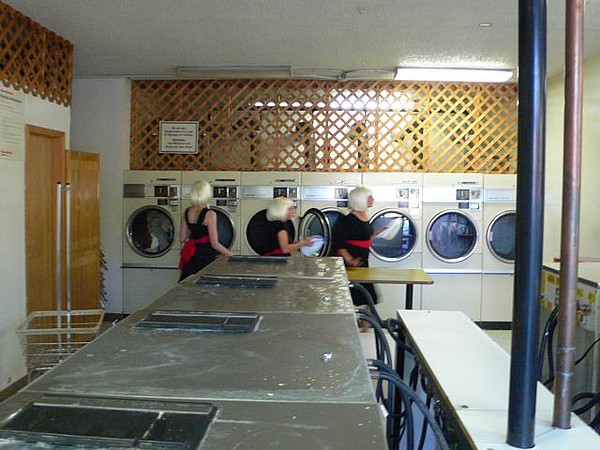
A year later, she performed it again, this time writing lyrics and dance moves for her backup singers, and providing them with matching outfits. When one of the singers cancelled at the last minute, Fenton had to take her place. Now short an audience, Fenton called a friend, and talked him into doing his own laundry while the singers serenaded him instead.
“Performance always cheers me up. It changes the tone of the day — completely. I dedicated a performance to something I usually take for granted…It felt as though I was praising the grocery and laundry gods for an hour.”
Fenton is currently planning a few more performances of the piece. These will most likely involving cleaning her house, and driving in traffic. With backup singers.
“It’s common to feel impatient or bored by things we do every day – brushing teeth, eating, making the bed, laundry, shopping, driving – and all the time it takes to do these things becomes convoluted and lacks presence because we think of the time as useless. But it’s not useless. We have to do these things, so why not find a new way to make them enjoyable? Art does this for me.”
–Chris Barr and the Bureau of Workplace Interruptions–
Groceries and laundry can be boring, but at least you only have to do them once a week. Work, on the other hand, happens a lot more often than that. Luckily, there is Chris Barr’s “Bureau of Workplace Interruptions” (2006-ongoing). Visitors to the Bureau’s website can sign up to have Barr or a volunteer from the Bureau interrupt their work-day.
“You know how receiving flowers at work can put a buzz on the rest of the day?” the website reads. “So do we. That’s why we create surprise, the kind that slices through the banal and opens up new places for your mind to wander. .. [W]e hope to invigorate some of the time you spend at work in order to create new experiences and possibilities outside the flow of capital.” All interruptions are guaranteed to not get you in trouble with your boss, too; the Bureau’s website stresses that their actions won’t be noticed by any of your coworkers.
Most of these interruptions take the form of emails. For instance, one volunteer who goes by the name Agent ChrisTwo invited an office worker to write a rap about his job. ChrisTwo starts him off:
“Yo, Yo, First City Loans is where Jason works,
His work is hard, have’n to give loans all day to jerks,
The office is nice but his cubicle is cramped,
the bathroom is clean but the floor is always damp.
“Your turn”
Another volunteer, Agent J, advises an office worker to confess her sins to her coworkers. “Please, don’t feel judged by me; I’m an atheist,” Agent J goes on to explain to the recipient. “We would like to hear back from you, though, to see if this has had any impact on the dynamics of your work-relationships.” Documentation of these and other interruptions are available in a database on the Bureau’s website.
“I think what is important,” Barr tells me over email, “is not just stealing time, but a recognition that contemporary labor utilizes and exhausts our communicative and cognitive functions. So, the important thing to me is to insert non-saleable communications into those channels.”
–Everyday exchange–
I also like to interrupt people during their daily grind. My “Everyday Exchange” (2008-ongoing) involves paying visits to participants while they shop for groceries, commute to work, or do their laundry. During this visit, I give people a small work of art I’ve made, or a poem I’ve written, that is specifically about this particular routine of theirs. My visit, and the gift I bring along, are meant to make their routine a little more interesting.
(From my website)
I base these gifts on conversations I have with the participants beforehand. During these conversations, we tell each other about our daily routines. For me, these conversations are the crux of the project. One of the reasons I started the “Everyday Exchange” was to get people to discuss and examine daily routines—both theirs, and someone else’s. I’ve found that no one really talks about these things, because they don’t want to bore anyone. But this reluctance can only cut them off from a number of interesting observations.
Because these routines actually can be very interesting. For example, who else is on the train with you, and what are they doing? (Do they look bored? Bothered? Are they checking each other out?) Or when you go grocery shopping, do you always buy the same things? (Some people do. Others don’t.) Our routines can be very interesting—if only we would pay enough attention to them every once in a while.
***
I asked Fenton if laundry and shopping were different for her as a result of her project. “Yes!” she told me. “I value those mundane acts more than I did… It’s pretty amazing what happens to the brain when you become microscopically fascinated by things before you.”
“Backup” added a bit of magic to Fenton’s routines. The performances also made the grocery store and laundromat a little more interesting for everyone else around her.
Despite the different agendas behind them, each of these three pieces produces a similar result: a blip of surprise, or wonder, in an environment usually fuelled only by boredom.

 rss feed