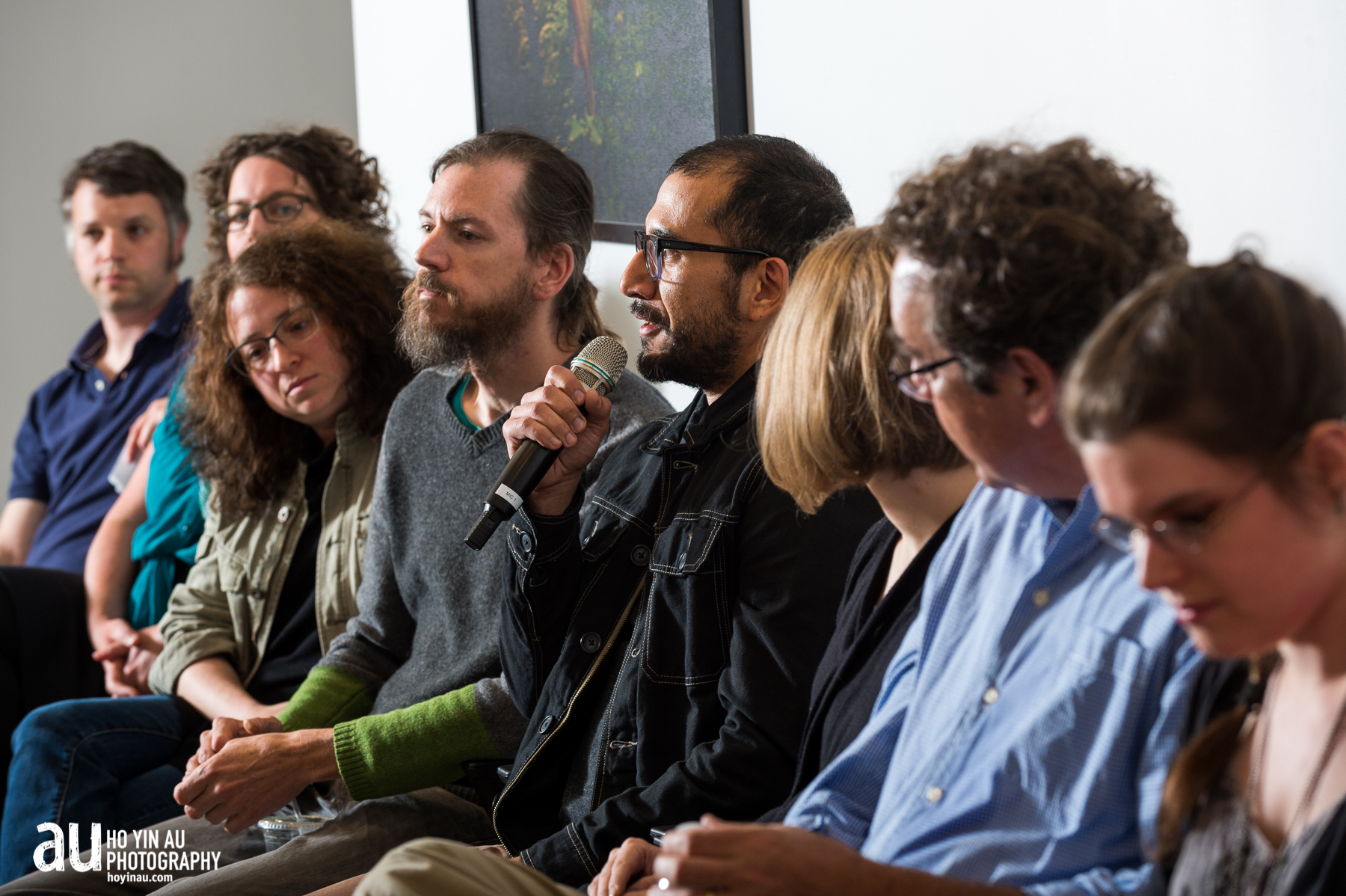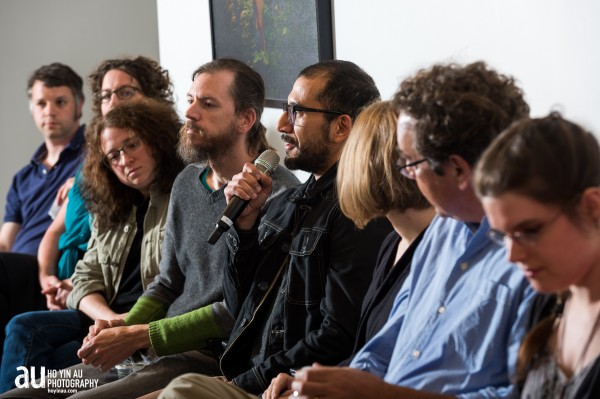
From the “How we get by” event. Left to right: Tim Devin, Andi Sutton, Heather Kapplow, Dirk Adams, Dave Ortega, Melinda Cross, Gregory Jenkins, Emily Garfield. Not pictured: Coelynn McIninch, Greg Cook, Jason Pramas, Shea Justice. Photo by Ho Yin Au
Last week marked the first anniversary of Getting by in Boston, or “GBIB” for short. It’s a series of meetings, an online forum, and a handful of related groups—all focused on how creative people (artists, writers, musicians & how) can survive in our famously expensive little Boston. The whole thing is pretty DIY, with different people taking the lead when they want to. And, weirdly enough, it all grew out of a single event that took place last June 4th.
That event, which Jason Pramas, Matt Kaliner, and I put together, was supposed to be a one-off thing. It was called “How we get by,” and featured 10 well-respected artists talking about how they make ends meet, and how they find the time and funds for their artwork. This was breaking some taboos, since creative folks don’t usually talk about how they pay their bills. First, it’s not how they identify themselves; second, there’s this weird notion that successful artists earn their keep from their art, so most people aren’t really upfront about the fact that they work—since it implies they’re not “successful.” So image everyone’s surprise when all but one of the speakers talked about their day jobs and their problems making ends meet. (Here’s an article I wrote about the event for the Mass. Cultural Council, and here’s Edmond Caldwell’s review of it for Big Red and Shiny.)
Over 100 people showed up for the event. There was a lot of energy there, so the next day, Jason, Matt and I set up a discussion group on Facebook called “Getting By In Boston.” After a few weeks, we also started organizing some follow-up meetings. Between the online forum and the in-person meetings, there were a lot of interesting discussions. And even some real-life outcomes.
—-The issues—-
More on the other meetings in a minute. First: what have the GBIB people been talking about? Well, there’s been a lot actually, which makes summarizing it pretty hard. But here are the four biggies:
- Community. Folks have been really interested in learning from each other, and figuring out ways to help each other out. There’s also been talk about the need for a greater sense of community among creative people. This surprised me at first, but it makes sense given how fragmented the creative scene really is.
- Money. No surprises here. The first event revolved around how few arts-related jobs there are, and how hard it is to try build a career in any given creative field—and how much work people are doing for free in the hopes of establishing a reputation that will lead to these things. This led to discussions about how little money there is in the local creative system in general, and how expensive it is to live around here—which is the reason so many talented people leave. Some solutions: coops, and sharing resources.
- Political situation of creative folks. One big thing that I was glad to see come up is the need for creative folks to band together and fight for what they need. There were lots of discussions about arts funding, zoning as it relates to us creatives, and social issues such as racial divides. For example, when I was getting ideas together for this post, Greg Cook told me that “Getting By helped clarify feelings I’d long had about the inequality (financial, gender, racial, sexual, age, geographic, etc.,) that so dominates the creative worlds—but perhaps previously I didn’t have the right words for.”
- Physical space. The high cost of living is the number one issue facing everyone who lives around here, not just us creative people. But the way this plays out for us is there aren’t many venues for producing and showing work, and the ones that do exist don’t last a long time. Just like our apartments. An online poll I put together last year showed that space was at the top of GBIB’s list of concerns; and posts by people looking for space, or announcing a space is closing are pretty common on the FB page. Rising rents force us to move around, which makes us complicit in gentrification—another topic that’s gotten a lot of play.
(There’s no way I could do justice to the whole discussion, so if you’re interested in learning more, take a look at the FB discussion group.)
—-Then there were a whole bunch of meetings—-
Like I mentioned, there was a lot of energy after the first event. But what should happen next? Did people want to move forward and get organized? Or were there existing groups or organizations that we could get involved with? Or both? At the first follow-up meeting, the consensus seemed to be that there were some wonderful organizations working already, but that we should focus on some of our own needs. We met again a few weeks later at Aeronaut (which Jesa Damora helped set up, after our first location fell through at the last minute); over beers, we discussed how we could organize ourselves, and a few people like Jason Pramas and Nancy Anderson pitched specific ideas.
—-So what’s come about of all of this? Meet the GBIB family—-
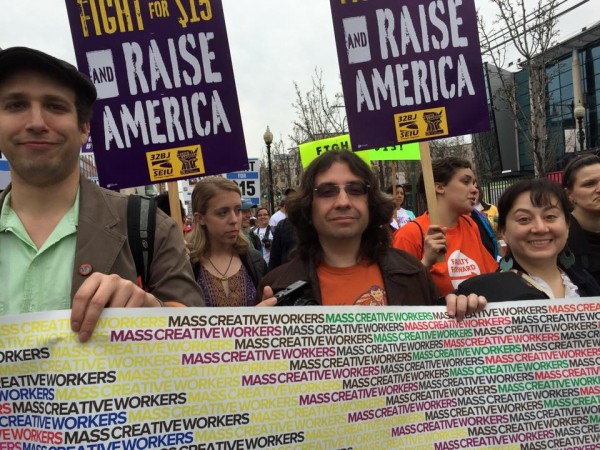
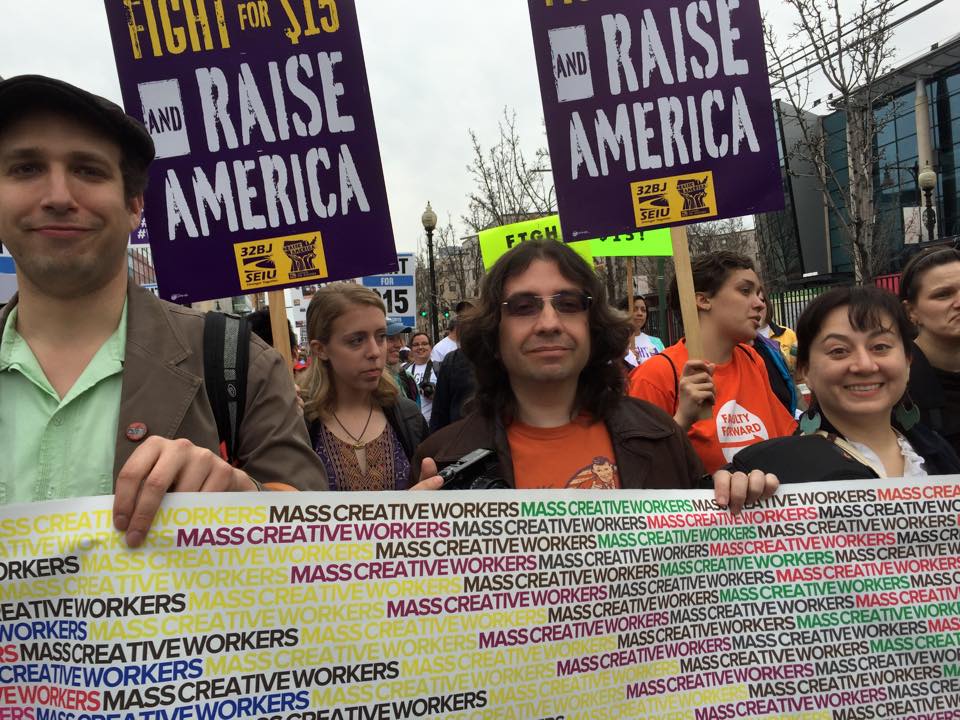
Mass. Creative Workers at the April 14th rally for living wages in Boston. Jason Pramas is in the center; Loreto Paz Ansaldo is on the right.
Mass. Creative Workers
One of the ideas we heard about at that third meeting was Jason’s concept of an association to “take action to improve wages, benefits, and working conditions in several creative industries.” A number of GBIB people signed on, and they began meeting regularly, calling themselves the Mass. Creative Workers. Among other things, they marched as part of the April 14 demonstration for fair wages in Boston. Anyone interested can go here for info on upcoming meetings and actions, or email them at masscreativeworkers@openmediaboston.org.
Off the Wall
Nancy Anderson also pitched an idea at the Aeronaut meeting. She was concerned about how hard it is to find a place to show your work, since there are so many artists competing for precious little gallery space. She wanted to match artists looking for places to show their work with businesses with wall space. She’s since partnered with Somerville Open Studios, and is about to go live (stay tuned). Off the Wall is a complete service for both the artists and the businesses: it curates the work, handles arrangements (including selling the art), promotes both the artists and business-partners on social media, and rotates work on a regular basis. You can email her at canis_major@mac.com for details.
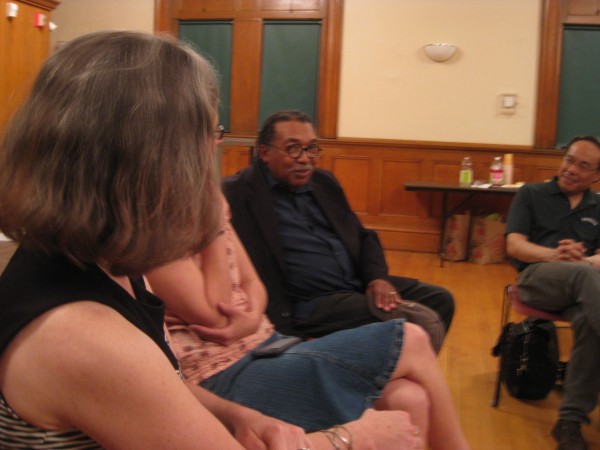
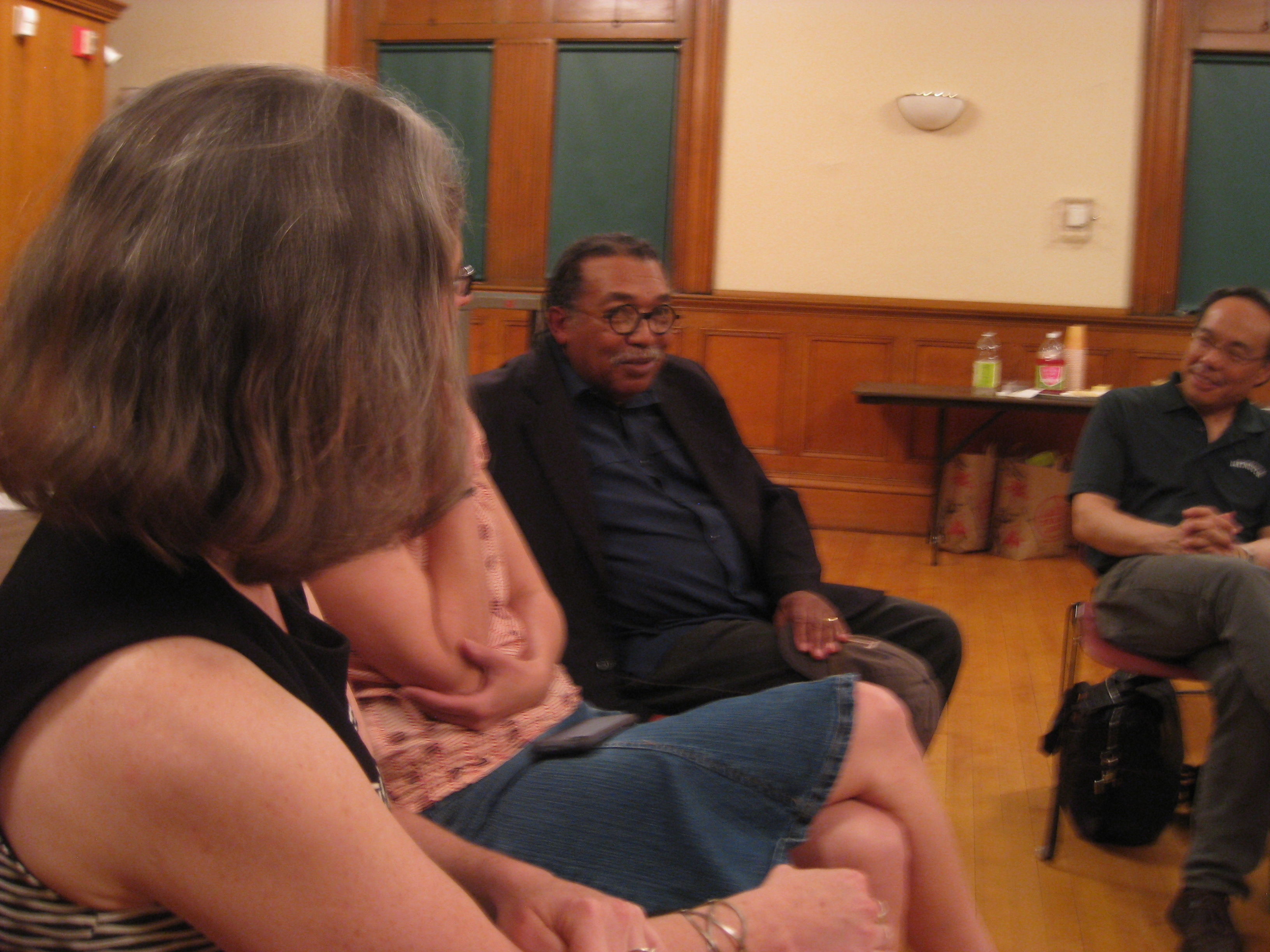
The first “how to be an artist and a parent” event. Speaker James Montford is in the center. Speakers not pictured: Paige Wallis and Stacy Thomas-Vickory.
How to be an artist and a parent?
One theme of the GBIB discussions is how to make ends meet, and still have time for creative work—something parents who are artists or writers or musicians feel pretty deeply. This realization led Greg Cook and me to start a series for creative parents called “How to be an artist and a parent.” We’ve had two events so far, and there’s also an online forum here. The idea is to swap notes on how to juggle our competing interests, how to manage time better, and to maybe find ways to help each other out. If you want to get involved, join the discussion on our Facebook page, or motor on over to our website here. You can read Greg’s summary of our first event here, and my article about the second one here.
Artists and Writer’s Mutual Aid Society
Another concern for GBIB folks seems to be a need for more community, and maybe some helpful motivation along with it. Be Be (aka Brenda Be) organized an event in Somerville last November along these lines, and called it “The Artists and Writers’ Mutual Aid Society.” She is currently reorganizing the idea as a regular series of monthly meetings. In addition to fostering community, this new group will be a place to find collaborators, share advice, and brainstorm. You can get involved by joining the FB group here.
—-The bottom line—-

Peyton, the GBIB mascot.
But besides some discussion meetings, a few new groups, and a whole lot of online chatter, what’s actually been accomplished?
Each creative form has its own niche community in Boston; as a result, people who could be working together not only don’t know each other’s needs—they don’t even know each other’s names. So it was interesting to see GBIB bridge this gap for a number of people. “It started with the visual arts,” fellow organizer Matt Kaliner told me, “but the later meetings did connect with theater a bit, especially after the closing of the Factory Theater.” And once that gap was bridged, people started realizing the challenges they face were related. Matt again: “I was really struck by the similar problems across genres.”
It’s also become a place where people discuss social and political issues. Beyond all of this chatter—and, most likely, because of it—I’ve seen GBIB folks at rallies and open meetings on arts funding, as well as more in-the-weeds things like meetings on Somerville’s new zoning code, and talks on artist-led gentrification.
Besides these shows of force, this energy has translated into at least one win: a new grant category. At “How we get by,” Heather Kapplow mentioned that the Mass. Cultural Council’s grants program supports a large range of media—but didn’t really address interdisciplinary work. This is important, since interdisciplinary work is arguably some of the most innovative (since it plays with different forms) and the least supported (because it doesn’t fall into existing grant and exhibition categories). After the event, a number of us (Philip Fryer, Andi Sutton, Kathleen Bitetti, Heather and myself) decided to approach the MCC. They were very receptive, and got back later in the summer to say that they’d expanded the sculpture/installation category to include “new genres,” which is specifically designed to provide an option for those working across disciplines.
Which I think is a lot for one year. But then again, I’m biased.
—-What’s going to happen in the next year?—-
The group has been going off in different directions lately, but that seems like a good thing: people are getting down to working on the part of the problem they think is the most important. So if one of the four existing groups appeals to you, get in touch! We’re all pretty open people.
But of course, there are tons of issues that affect us here, so if something’s bothering you beyond those four issues, we hope you’ll bring it up on the forum. Maybe others will agree, and we can get started on it. Let’s make it happen.
Special thanks to the folks who let me pick their brains: Brenda Be, Coelynn McIninch, Greg Cook, Heather Kapplow, Jason Pramas, Matt Kaliner, Michael Goodman, MJND, and Nancy Anderson.
My 2009 project “26 Passports” will be on exhibit at Angel’s Gate Cultural Center in San Pedro, CA from February 9 – April 11, 2014. This is the first time this piece has been shown. More details below.
Gettin’ Off The Ground: Contemporary Stories from An American Community
curated by Isabelle Lutterodt
Opening Reception Sunday Feb. 9, 2-5pm
Angel’s Gate Cultural Center
3601 South Gaffey Street
San Pedro, California 90731
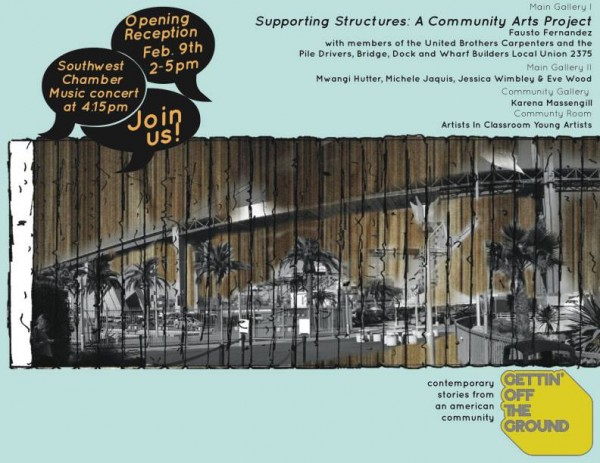
Angels Gate Cultural Center (AGCC) is thrilled to invite you to the launch of a new round of exhibitions that continue to explore how stories within the community shape the collective consciousness in San Pedro and South Bay area.
An Opening Reception for several new shows in the Galleries will be held on February 9, 2014 from 2:00pm-4:00pm. Chamber Concert at 4:15pm.
MAIN GALLERY I: Supporting Structures: A Community Arts Project – Fausto Fernandez in partnership with members of the Southwest Regional Council of Carpenters and the Pile Drivers, Bridge, Dock and Wharf Builders Local Union 2375
This project marks the beginning of a year-long partnership with the Union. Together we will explore the story of their members and families, the history of the labor movement in San Pedro and how this impacts the community at large. Los Angeles based artist Fausto Fernandez was selected by the Joe Baker, Executive Director of Palos Verdes Art Center, to work on the project.
MAIN GALLERY II: features artists: Mwangi Hutter, Michele Jaquis, Jessica Wimbley and Eve Wood
Work has been selected that continue to explore stories relevant to the local community. The work ranges from video to sculpture and explores issues of representation, identity and personal responsibility. Visitors will be able to tell their own story through interactive art stations in the gallery.
COMMUNITY GALLERY: Symbiosis – Karena Massengill with students from Cabrillo High School in Long Beach.
San Pedro based artist Karena Massengill will be showing work alongside her students work from Cabrillo High School in Long Beach, CA. The work represents the creative conversation that emerges between artist-teachers and students.
COMMUNITY ROOM: Artist-In-Classroom will showcase young artists from South Bay schools.
Features work by young artists from local and regional schools in the South Bay/Harbor region who have been instructed by Angels Gate Cultural Center’s Artists-Teachers
Following the reception, join Grammy Award-winning Southwest Chamber Music in Building H for a one-hour program featuring violinist Shalini Vijayan playing pieces from J.S.Bach, Kurt Rohde, Lera Auerbach, and Hyo-shin Na, and talking about classical and contemporary music.
This program is part of the Music Unwrapped series of free community concerts. These informal and interactive performances are designed to break down the barriers between musicians and audiences of all ages.
Angels Gate Cultural Center galleries are open to the public Monday through Friday from 11 a.m. to 5 p.m., and on the second Saturday of the month from 12 – 5pm. Admission is always free.
What you should know and be able to do
Sarah Rushford
October 25 – November 30, 2013
Opening Reception: Friday, October 25th — 6-9pm
Artist Reading and Screening: Saturday, November 2nd — 7-9pm
Sarah Rushford will read from her poetry manuscript and several short video works will be screened.
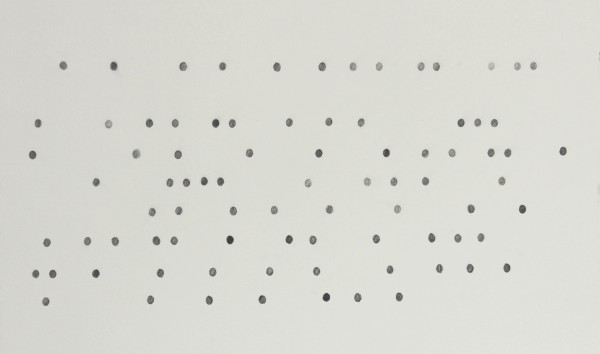
What you should know and be able to do (text voids), 2013, graphite on paper
The Hallway Gallery is excited to announce its next solo exhibition featuring the interdisciplinary work of Sarah Rushford. What you should know and be able to do will feature text art, works on paper, video, audio, and sculpture by Boston-based artist, Sarah Rushford.
Sarah earned her BFA from Hartford Art School in 1998 and MA in Media Studies from The New School in 2001. As a multimedia artist she is currently working in writing, video, and collage. She recently completed art and writing residencies at TAKT Kunstprojektraum in Berlin and Art Farm in Nebraska. She has exhibited in Boston, New York, Los Angeles, and Berlin.
I make art across diverse media and I use ordinary materials and objects like flour, talcum powder, children’s games, sewing needles, ice, pins, text. The processes performed on these are simple, and remain simple. Dots, lines, letters and rubbings are made, fabric is folded, the camera is fixed, objects are pressed onto paper, holes are poked. The almost over-simple gestures accrue a vulnerable, striking, beauty; a transcendence. My process is impatient, imprecise, inarticulate, playful, and I often feel foolish. When a project comes to fruition, I have a mastery of a strange skill. I am working to articulate this mastery that exists on a continuum with foolishness.
The works are that of noticing and invisibility; they are about the anomaly that the vivid interior self and the living argument of consciousness can be sharp and definite to the individual, yet invisible to the outside, to others, and to science.
The Hallway Gallery
66a South St
Jamaica Plain Ma 02130
thehallwayjp.com
Gallery hours:
Tuesday-Saturday 10am-6pm
Sunday 12-4pm
& by appointment
If you’d like to set up an interview with Sarah Rushford or schedule a private viewing of the exhibition, contact me at your convenience.
Sarah Rushford’s What you should know and be able to do
was featured in Artscope magazine’s weekly emailed exhibitions roundup:
in Jamaica Plain, Massachusetts October 25th through November 30th
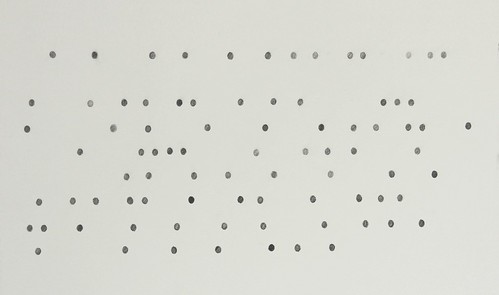
What you should know and be able to do (text voids) by Sarah Rushford, graphite on paper, 24″ x 16″.
Have you ever felt like you’re floating through whatever you’re doing at the moment? Perhaps it’s a craft, a skill, or a career. What’s important to note is that the floating isn’t a surrender or a sign of boredom; it’s a movement from control to subconsciousness, from instruction to intuition. Interdisciplinary artist Sarah Rushfordexperiences this exact sensation as she works on projects, allowing her to transcend the boundaries of craft and theory and focus solely on the simplicity of the process.What you should know and be able to do is Rushford‘s solo exhibition of text art, works on paper, audio, video and sculpture that come from a space between the living argument of consciousness and the vivid interior self. Of her process, Rushfordsays, “I have a deep trust in intuition. I know there is a thinking that is above my conscious thinking that comes through doing. To get at these higher connections that are made, miraculously, I have to be very busy with the ‘lower-level’ work, much of which is cast off when the final work is realized.” This creates final products of simplicity: materials like flour, sewing needles, ice and children’s games and techniques like rubbing, folding, fixing and pressing. The almost over-simplistic nature of her projects leaves us with a strikingly vulnerable beauty. “My process is impatient, imprecise, inarticulate, playful, and I often feel foolish,” Rushford says. “When a project comes to fruition, I have a mastery of a strange skill. I am working to articulate this mastery that exists on a continuum with foolishness.” The level of honesty and universality radiating from Rushford and her works is appealing to anyone of any background, any discipline. As a multimedia artist, Sarah Rushford is currently working in writing, video and collage. In 2010, she started Circadia, a web and print design company for artists, small businesses and non-profits. She is also a member of Rise Industries, a forum for exchange between artists and a starting point for interdisciplinary collaborative projects. What you should know and be able to doopens tomorrow, Friday, October 25th at Hallway Gallery with an opening reception from 6-9pm. The exhibition will run through Saturday, November 30thand will feature an Artist Talk/Screening on Saturday, November 2nd from 7-9pm.
A few months back (yes I am really slow with posting these days) we caught the closing reception of Constructing Fantasy at the Beacon Arts Building curated by the BAB director, Renée Fox – a really fantastic local sculpture show, in a space which has been doing a lot of fantastic things. Sadly, Renée told us that the gallery will be closing (by the time I got around to posting this it has closed) – though the studios throughout the rest of the building will of course remain. Perhaps another art space will move in there, and I hope Renée and the team behind the shows will continue to put on shows at some other venue. I only made it to a handful of the shows over there at Beacon Arts, but always found something I liked. This one in particular had a lot to like.
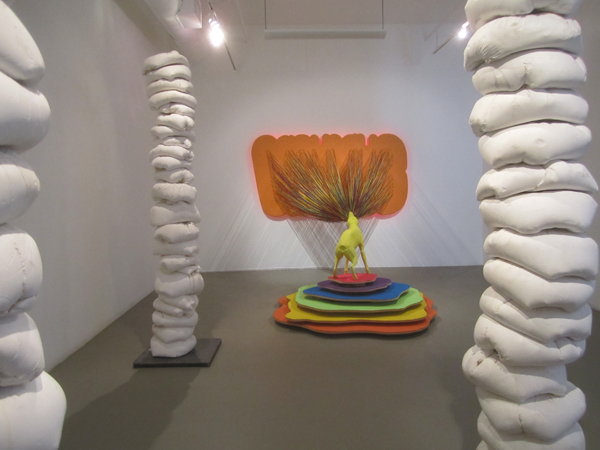
Vesuvius, Travis Novak (in background)
The Spirit, The Breath, The Flesh, Larissa James (foreground)
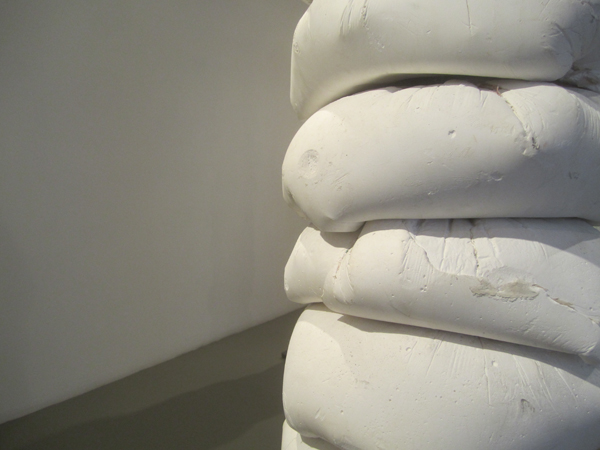
The Spirit, The Breath, The Flesh, Larissa James
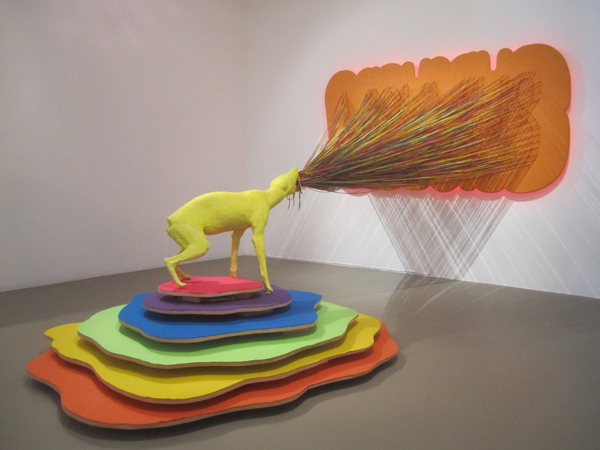
Vesuvius, Travis Novak
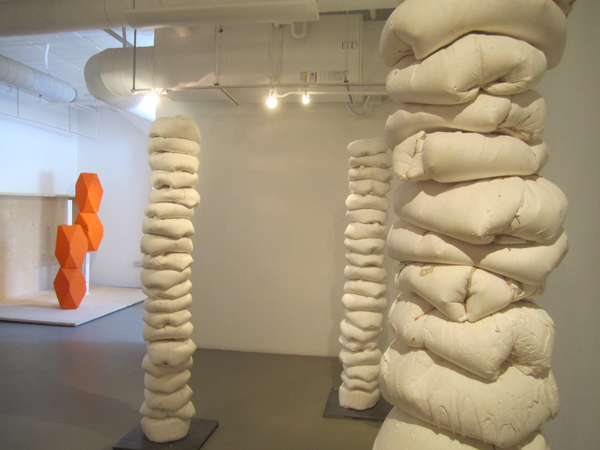
Untitled #14, Jefferey Hastings (in background)
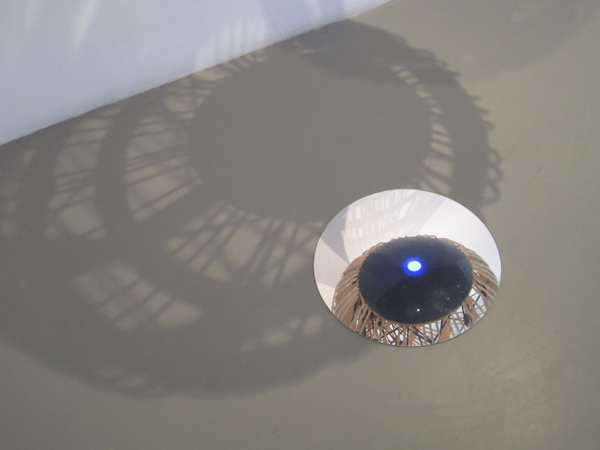
Go Hard, Eric Johnson
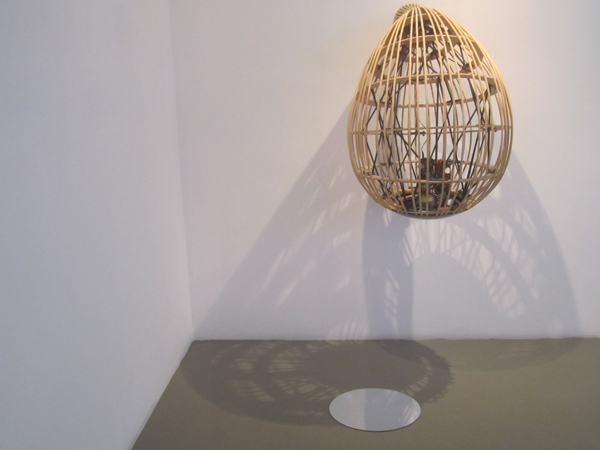
Go Hard, Eric Johnson
Go Hard, Eric Johnson
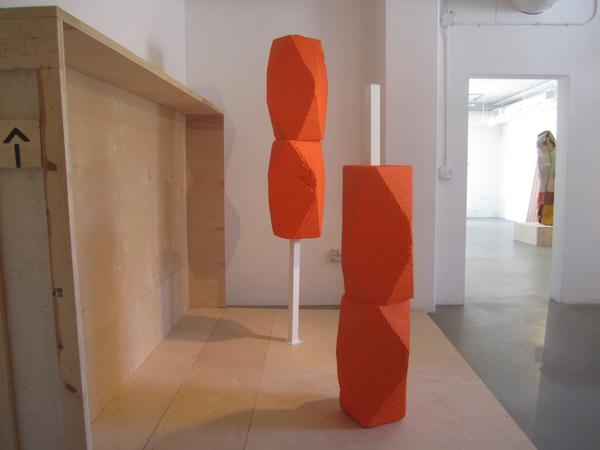
Untitled #14, Jefferey Hastings
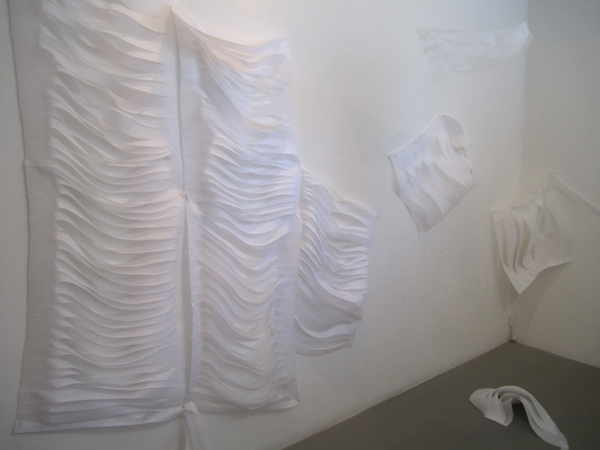
Wind Blowing… Ripples Running, Snezana Petrovic
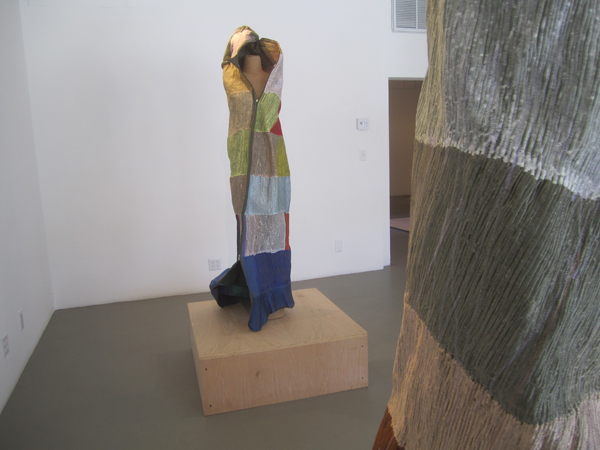
Just a Secular Babe, Catherine Fairbanks
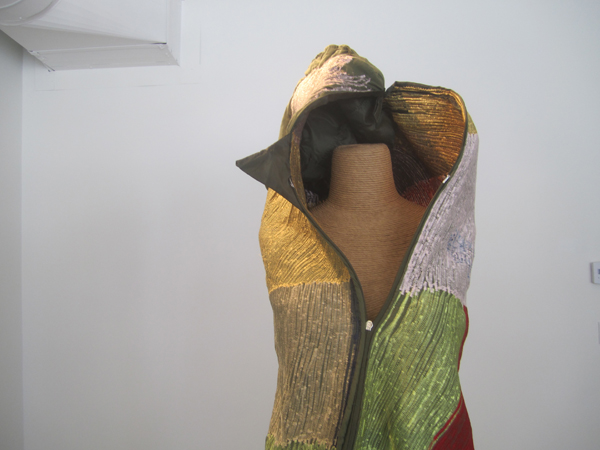
Just a Secular Babe, Catherine Fairbanks
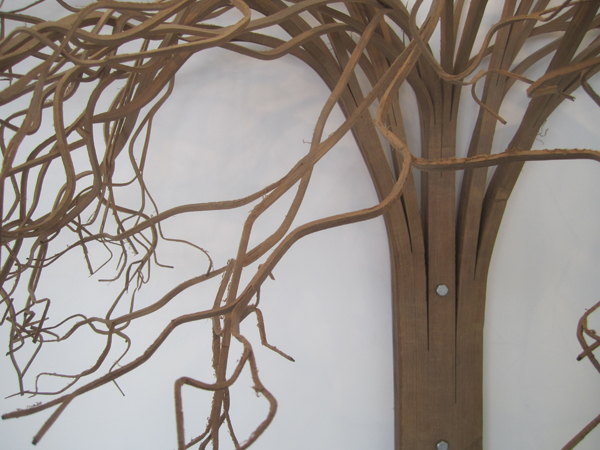
Slab 1, Pontus Willfors

Untitled, Catherine Fairbanks
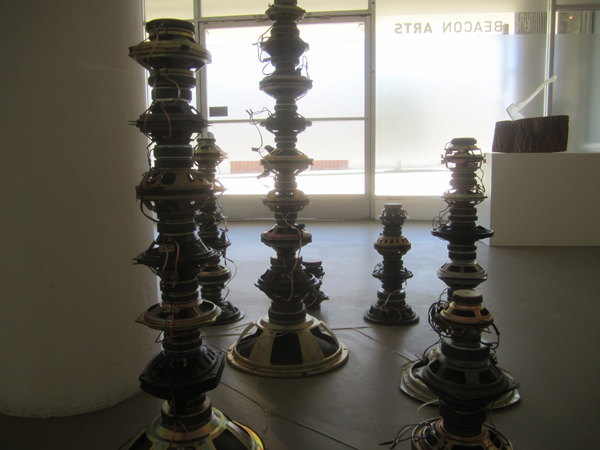
Metrophonix, Winter Jenssen
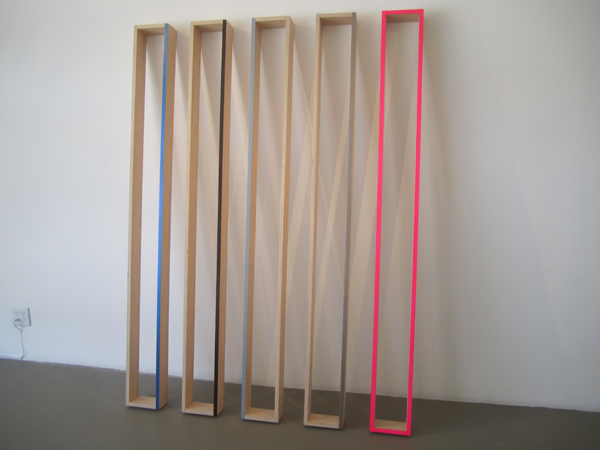
Untitled, Sophie Lee
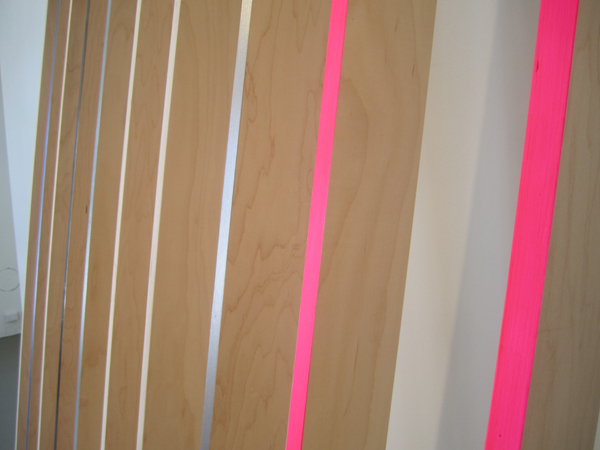
Untitled, Sophie Lee
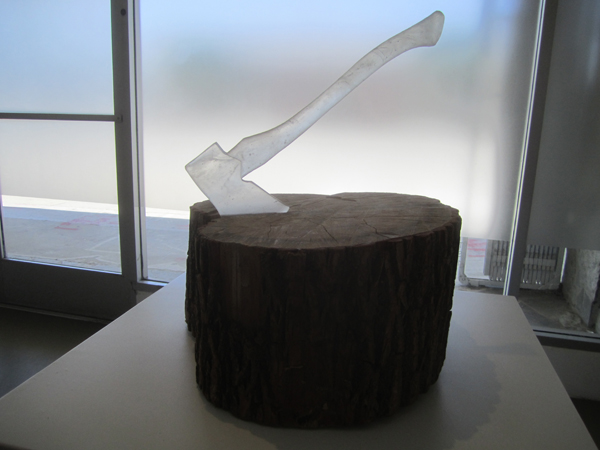
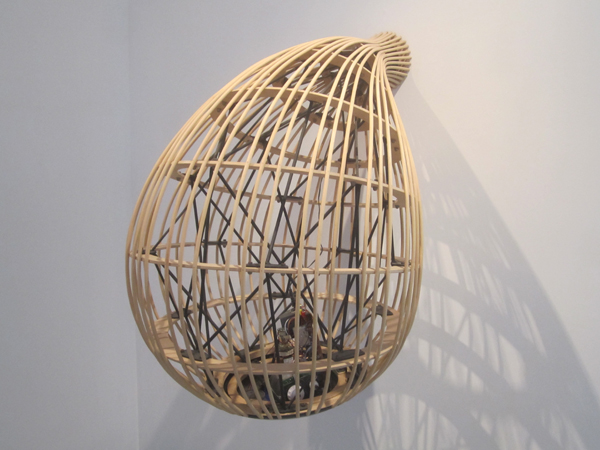
Hatching, Rachel Kaster
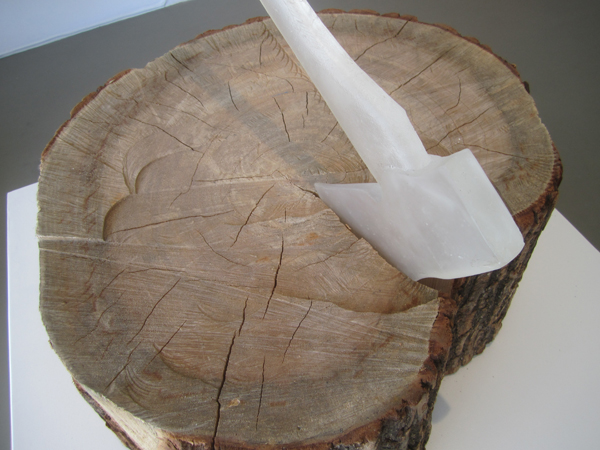
Hatching, Rachel Kaster
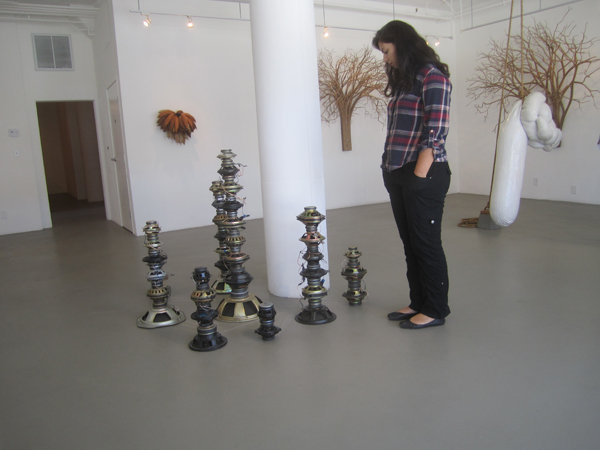
Metrophonix, Winter Jenssen
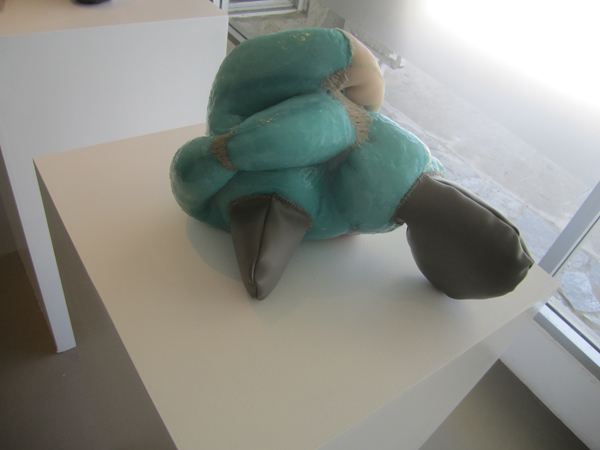
I May Be Getting Tired of This Arrangement, Michelle Carla Handel
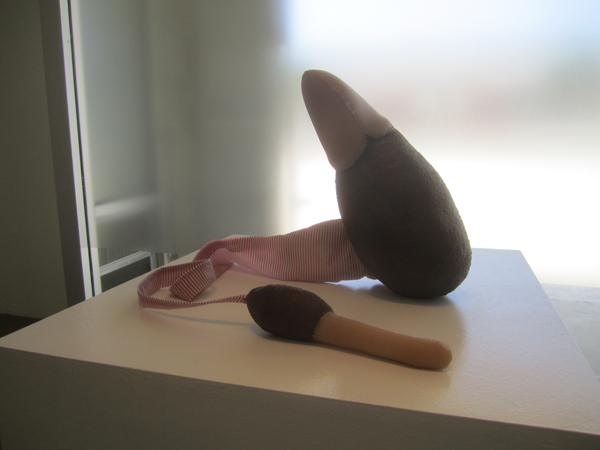
Okay, So I Do Need You, Michelle Carla Handel
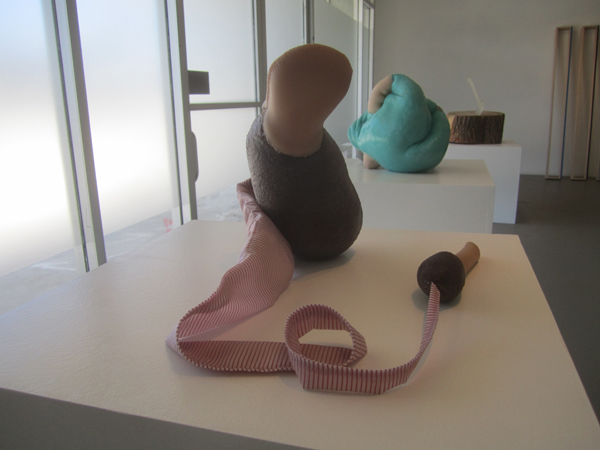
Okay, So I Do Need You, Michelle Carla Handel
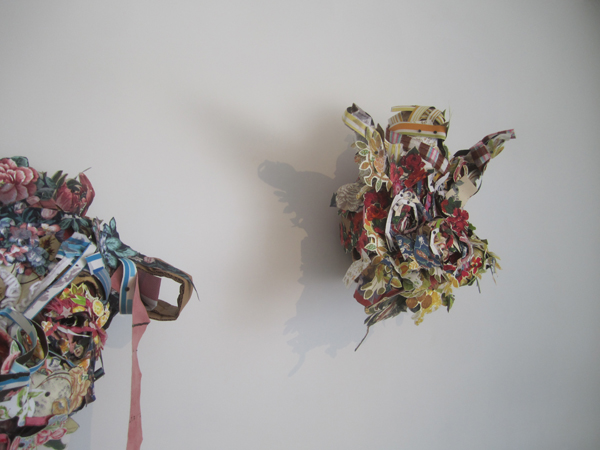
No Name, Elisabeth Higgins O’Connor
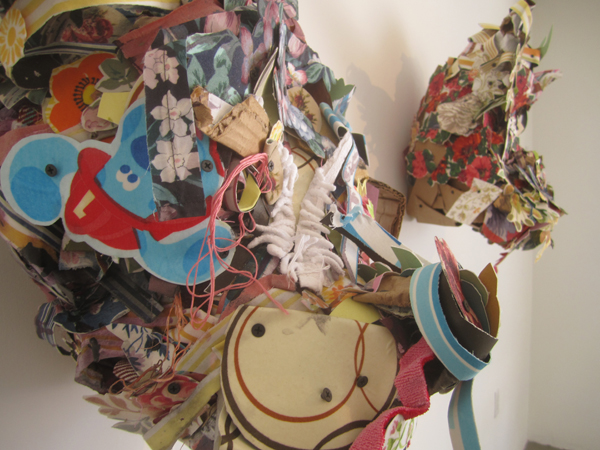
No Name, Elisabeth Higgins O’Connor
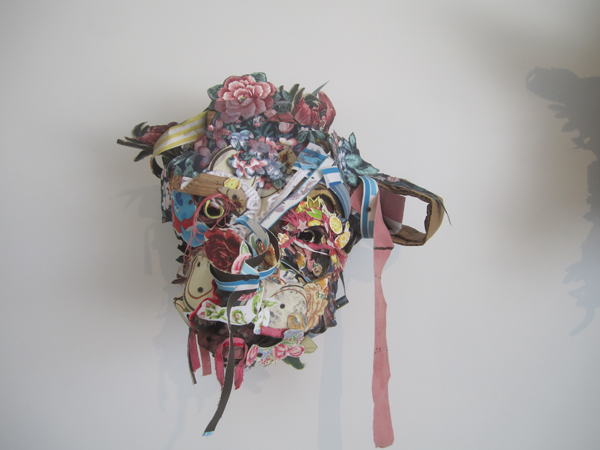
No Name, Elisabeth Higgins O’Connor
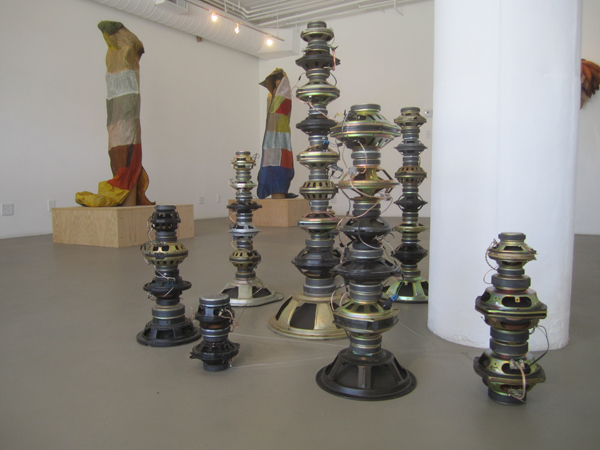
Metrophonix, Winter Jenssen
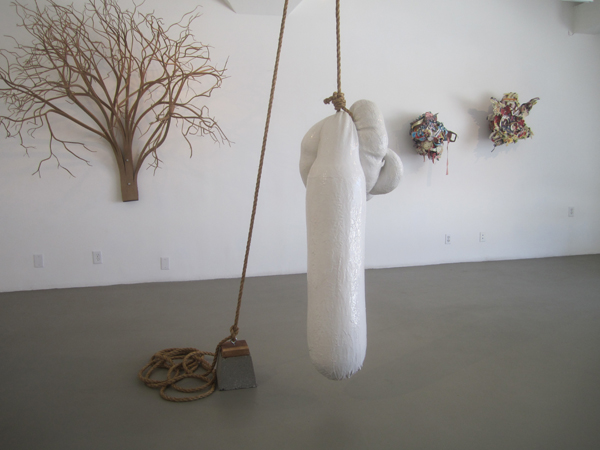
Feeling Your Love, Michelle Carla Handel
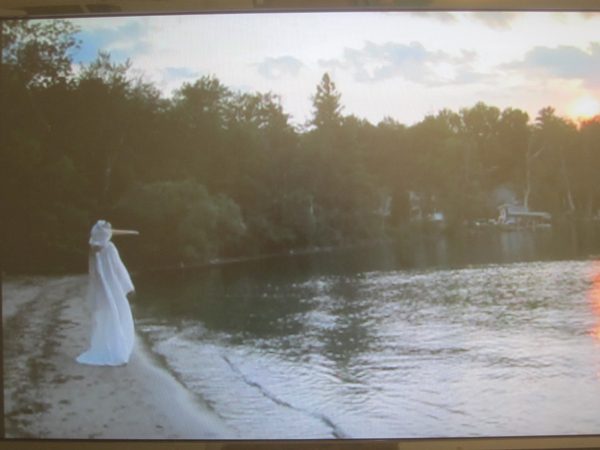
Transference is Tough Row to Hoe, Catherine Fairbanks (video)
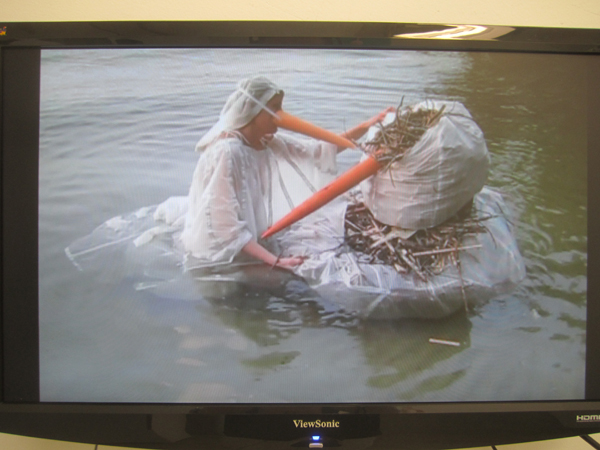
Transference is Tough Row to Hoe, Catherine Fairbanks (video)
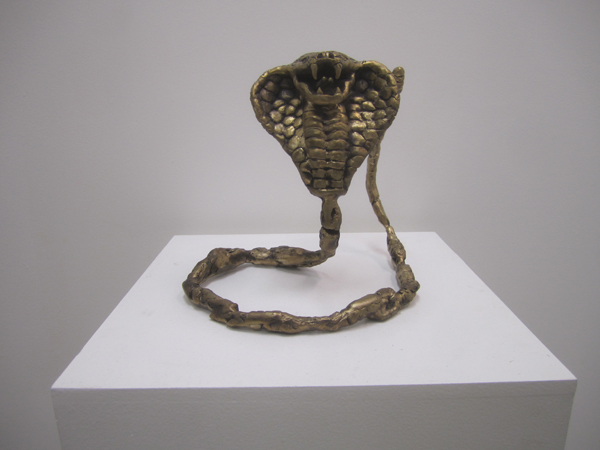
Welcome to the Jungle, Larissa James
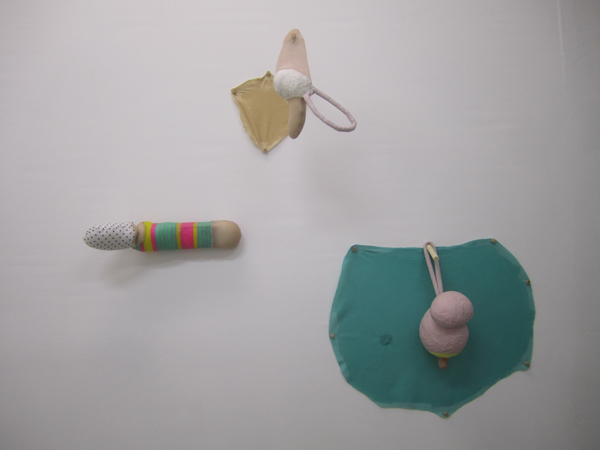
several works by Michelle Carla Handel
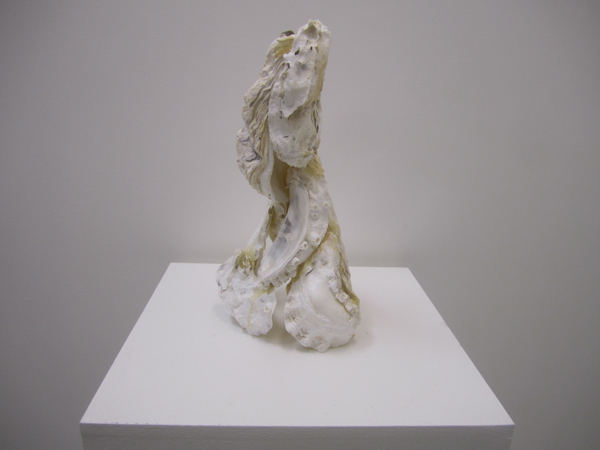
The Universe is Inside of You, Larissa James
Last Saturday was the annual performance art extravaganza, Perform Chinatown. It was a long evening, 4pm-midnight. We stayed most of the time, but didn’t see everything, and was I disappointed to miss Karen Finley at Coagula Curatorial, but here’s some highlights of what we did see…
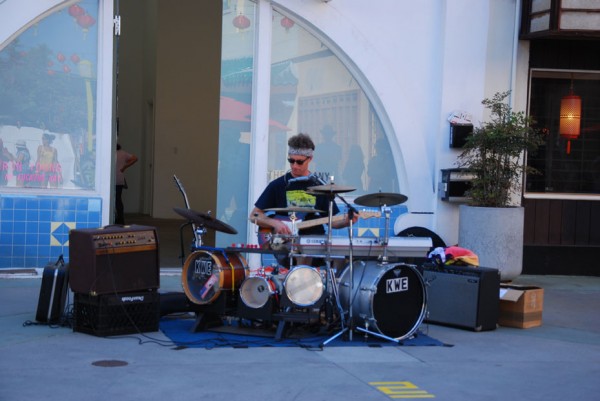
It all started with the amazing one-man band, Keith Walsh Experience. He played for close to two hours, non-stop. Such energy and stamina.
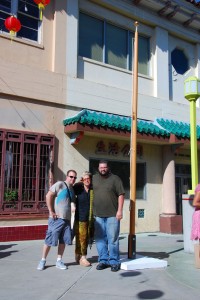
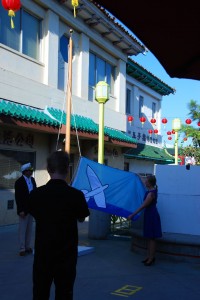
Jeremy J Quinn and Jerri Allyn with Erich Wise and his hand made flag pole, borrowed by McLean Fahnestock for their Flag Raising.
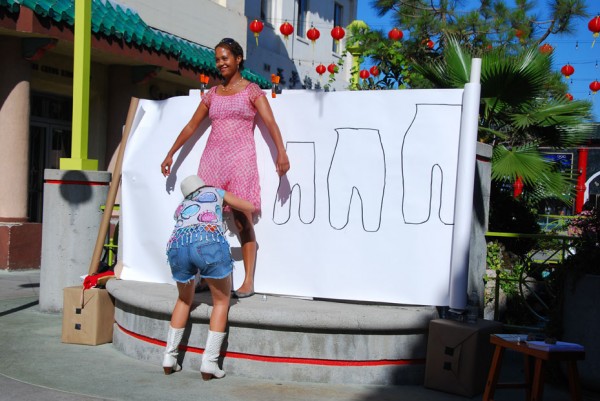
Allie Pohl traced participants bodies onto a large scroll as an index of “The Ideal Woman.”
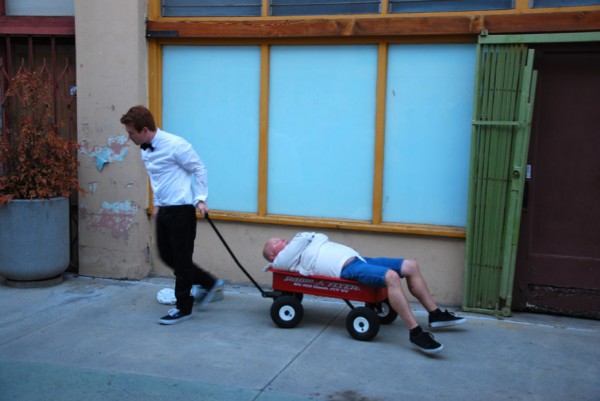
After being shaved and fit into a straight jacket, Kent Anderson Butler was dragged by his barber up and down Chung King Road in a little red wagon. I’m often intrigued by what Kent will put his body through for the sake of art.
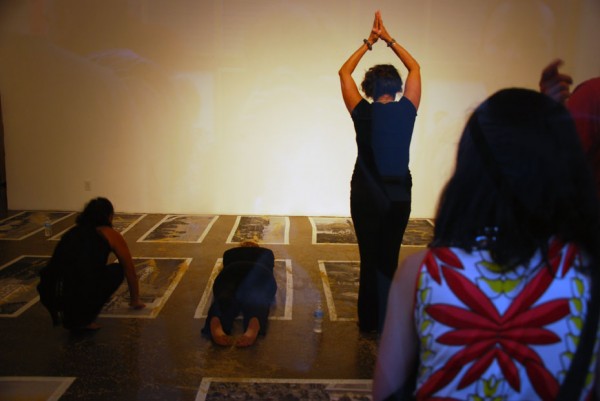
While inside Happy Lion/Mirror Gallery, Jocelyn Foyce led participants in a meditation over rice and black and white images inspired by her travels in Tibet.
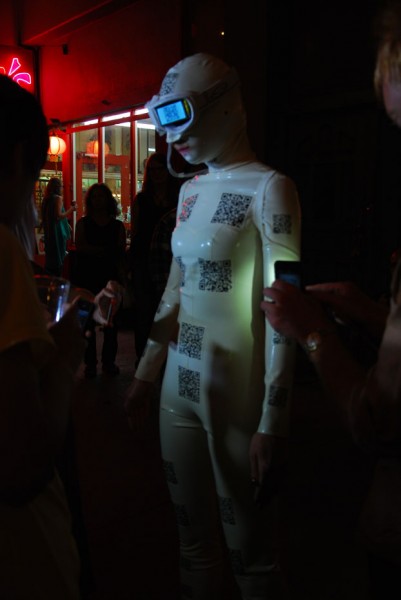
As darkness fell, Tiffany Trenda walked through the growing crowd wearing a skin tight suit that compelled onlookers to pull out their smart phones to scan her with their QR Readers. I’ve never gotten those apps to work properly, so didn’t try it, but according to her website the scanned codes link to “information on the effect of man-made materials have on the human body.”
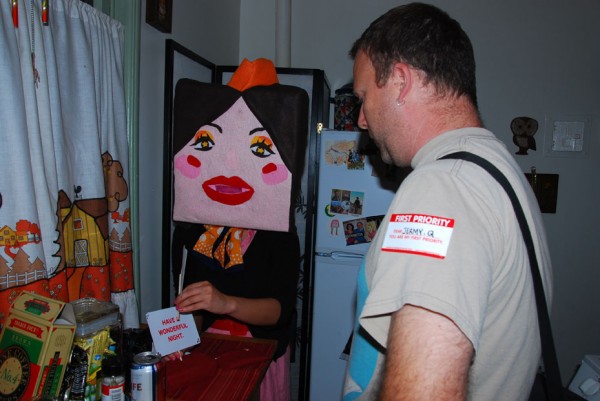
Jeremy enjoyed being greeted by Miggie Wong as part of the gentle beings benevolent association presents Perform Wow!
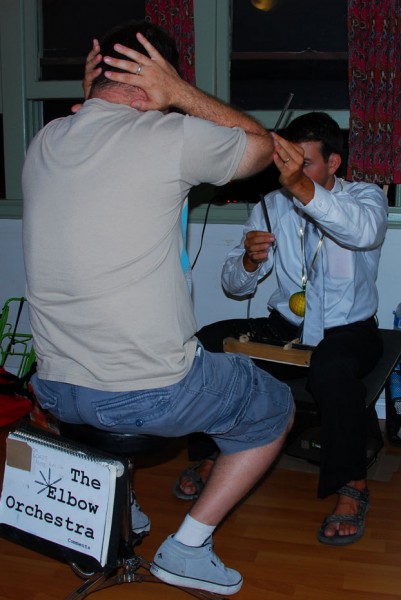
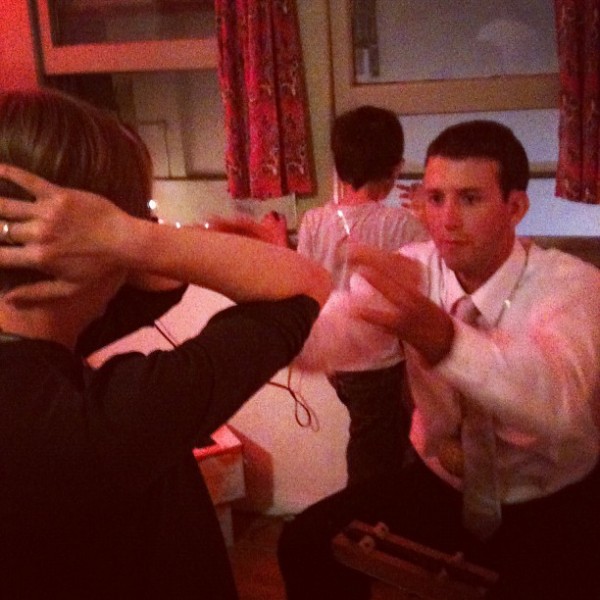
And we both enjoyed listening to tones resonate through our forearms, as James Kennard of the Elbow Orchestra held tuning forks to our elbows, also at Perform Wow!
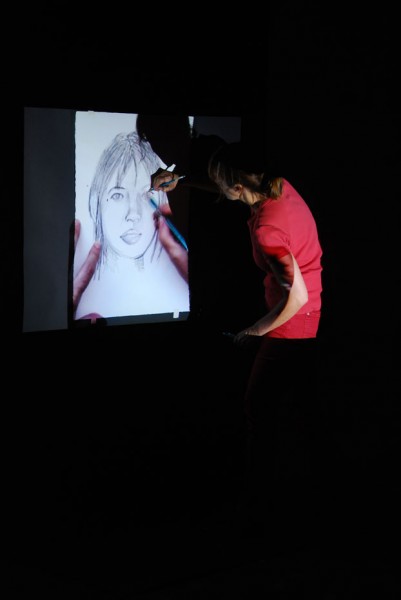
But the most compelling and moving piece was Elizabeth Leister‘s Disapeared. Jeremy and I walked into POVevolving just as she was setting up for her second drawing in an ongoing performance in which she traces the video projection of previously drawn portraits, played in reverse motion so that it appears as if the pencil is erasing the image of a woman. She did this three times, each with a different drawn portrait based on Los Angeles County missing person photos. You’d only know this if you stuck around long enough to hear the video’s voice over recite the missing person’s “vital statistics,” or if you read her project description. Haunting to say the least.
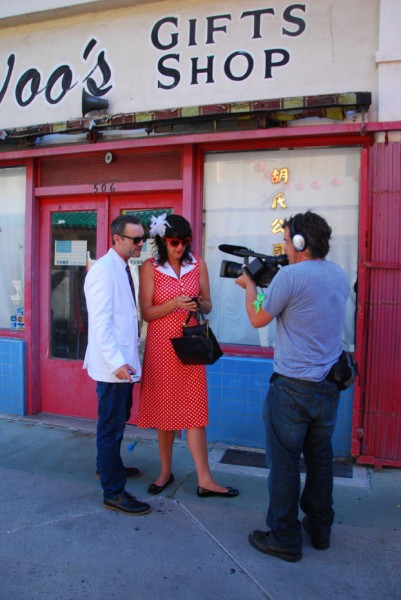
To see more we’ll all have to keep a look out for the video commentary by Dave Burns and Paige Wery, of Artillery.
I am excited to announce the final edit of my 2009-12 project, i dream in your language, will premiere in MIA: Strange Loop, curated by Alanna Simone, at the Armory Center for the Arts, Friday July 27 at 7pm. Here’s the press release:


FOR IMMEDIATE RELEASE
MIA SCREENING, STRANGE LOOP
New Series Screens Video Art & Experimental Films
Please join us for the July screening of MIA at the Armory!
This month’s event takes place on July 27th at 7PM and features five projects each dealing with communication and misunderstanding.
Orgasmatique, Dramatique, Horror (2009) is a short performance questioning the portrayal of women and emotion in pornography, melodrama and horror films from Washinton D.C. artist Melissa Bruno.
Los Angeles artist Michele Jaquis envies people who speak multiple languages. Her series, i dream in your language (2009-2012) investigates the experience of seven such people, revealing the complex negotiations they undertake to translate and interpret words and meaning.
San Francisco based Whitney Lynn asks a rabbit (repeatedly) to ‘sit’ for a portrait in Commissioned (After W.W.) (2010).
The Complect Voice (Suite for Birds and Mammals) (2012) attempts to include a variety of animals in a musical collaboration with the artist Julie Rooney and composer Jonathan Sokol, both based in Boulder, CO.
The Foreignness of Language (2011) by Nina Ross explores the disruption of personal identity the artist experienced as she incorporated a second language after leaving Melbourne, Australia to live in Norway.
The MIA series began in June of 2012, founded by video artist Alanna Simone to promote the work of artists who use the moving image. Every 4th Friday the MIA series screens video art, experimental films, performance art, essay films and animation from local and international artists at the Armory Center for the Arts, 145 North Raymond Avenue, Pasadena, CA 91103 (map). Each program is organized around a theme and lasts a little over an hour. A donation of $5 is suggested.
Its been a busy art making summer so far for all the Rise members, including me. Since mid May I’ve been enjoying my two day a week schedule at Otis (as opposed to four during the school year) and I’ve been putting in a lot of time at the studio preparing exhibition proposals for work that’s been completed over the last three years and digging into a project I began last fall…
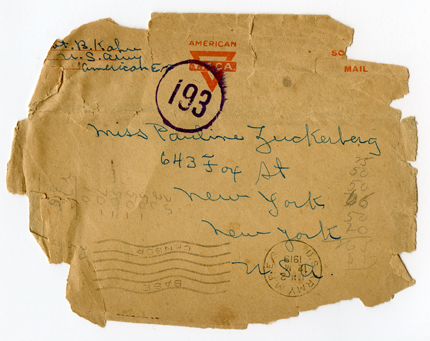
In 2004 when my family and I cleaned out my grandparent’s home after their deaths we found a bundle of letters written from my great-grandfather to my great-grandmother. The plan was that I would take them all home, scan them and distribute CDs of the files to our immediate family members. I started scanning some in 2005, then several other projects took over my time and I didn’t get back to it until this past October. My grandmother’s sister has since died (back in December 2009), and we’ll be spreading her ashes in Central Park this summer. She would’ve loved to have read the letters, as Zaydie Bernett (Ben) Kahn and Bubbie Pauline (Zuckerberg) Kahn were her parents. What I find fascinating about the letters is not only the great love affair between Ben and Pauline, but also the descriptions of turn of the (20th) century New York City, Long Island and parts of Europe while Ben was traveling with the US Army – a great example of immigrants serving their new country before their citizenship was earned, but that’s another story… The letters are written mostly in English (which I believe was not a first language for either of them Ben being from Russia and Pauline being from Latvia) with bits of French and Yiddish, although I think my sister and I are the only ones in our family who referred to them in Yiddish, and I recall my grandfather yelling his corrections, “NO! ONLY MY MOTHER IS BUBBIE!” But whatever, to me any woman from the old world with grandkids and great-grandkids is “Bubbie.”
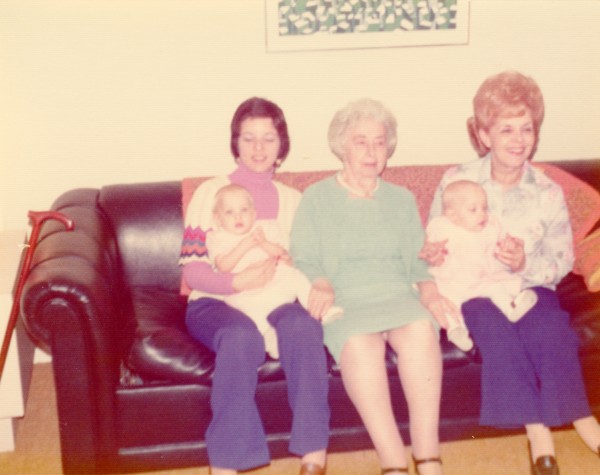
Although memory can play tricks, in most photos that I recall Bubbie Pauline wore a turquoise sweater, shell top and skirt set that she knit herself. I could tell that it was her “dressy-casual” attire. While everyone else seemed to have different clothes on, and many photos are clearly from different time periods, she seemed to wear this same outfit on so many occasions that were not weddings or bar mitzvahs, but still called for family photographs.
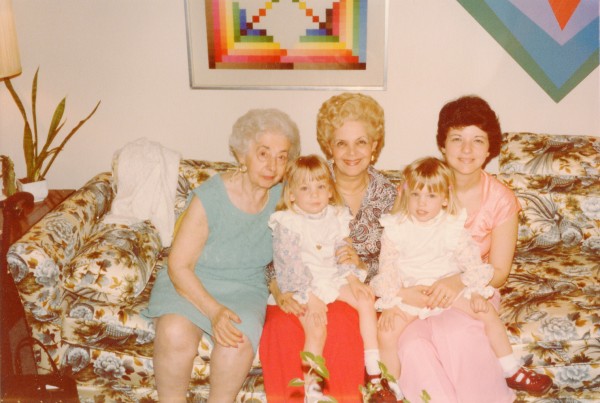
While in high school I inherited a matching sweater of a different color, also knit by Bubbie Pauline. My grandmother, who must have gotten it when her mother died, didn’t want it anymore.
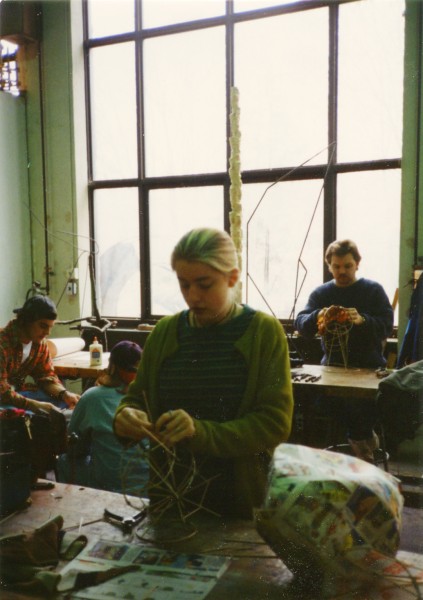
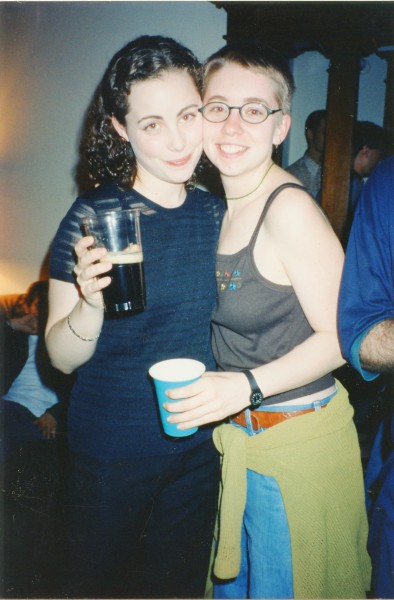
It was a perfect puke-green color and I wore it all through high school, college, and graduate school, until a slightly embarrassing moment, when after years of wear and tear, a professor that I knew from undergrad whispered to me while at the 2000 CAA conference, “Its good to see you, but you shouldn’t wear that sweater anymore.” So Bubbie’s sweater went onto a top shelf in the closet and each time my husband and I made thrift store donations, her sweater was spared.
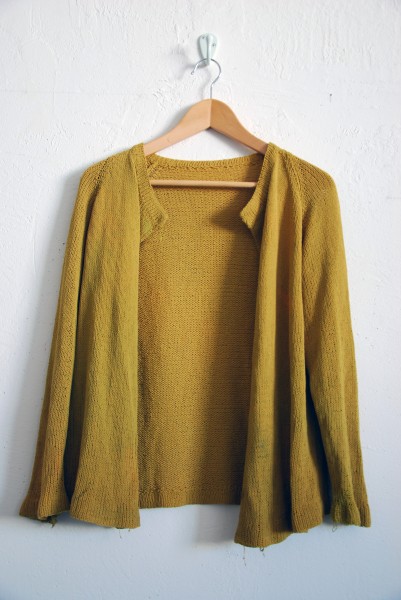
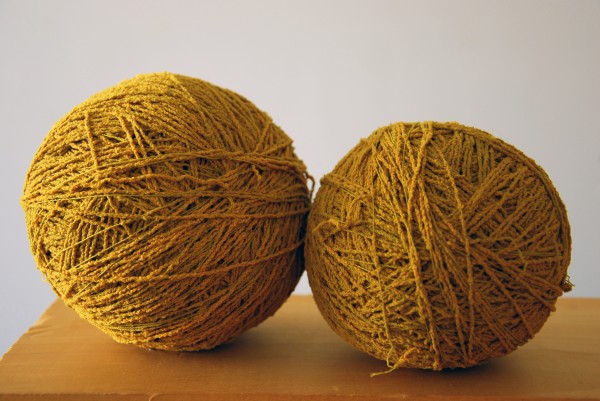
In addition to scanning the letters Bubbie received from her loving boyfriend who later became her husband, I began to unravel her puke-green sweater, with the intention of using the yarn to embroider something inspired by the text in all the letters. I am still not sure what exactly that will be, but for now I’m not worrying about that.
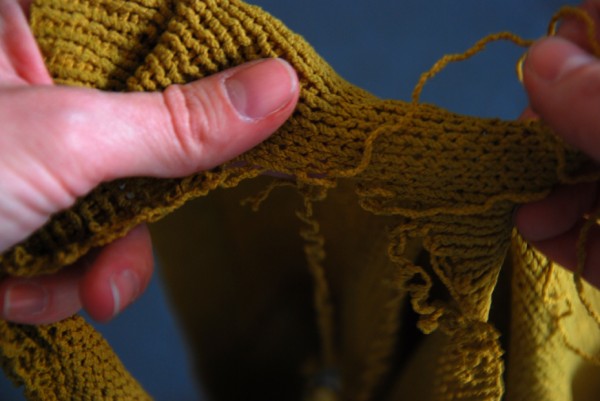
Partially through the first hour of unraveling, I felt a slight sadness. I was destroying one of the few remaining artifacts from that generation of my family on my mother’s side – the others being a set of Shabbat candlesticks and a ton of snap shots. But after a while, and I worked on this for several months, I felt a sense of satisfaction as I realized that my hands were touching every strand of yarn in the opposite way my Bubbie’s hands did.
I’ve rented a studio space in Boston’s SOWA District! My new home is in the 450 Harrison Ave Boston #309b. The space offers me the opportunity to show work the First Friday of each month, and also at SOWA artwalk 2x per year.
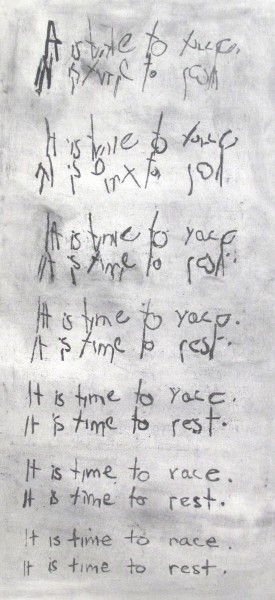
In my new studio, I recently finished this 24″x48″ canvas “It is time to race.” This is a distillation of the process I began last summer at the ICI residency. I found this phrase in a grammar textbook, I think of it as a sort of found poetry. I copied the phrase over multiple times, but copied over the reverse of the words, so as to force my eye to only draw the seen shapes, instead of automatically re-writing complete words. This is a transfer of a selection of the copies, to canvas.
More work from my residency at Vermont Studio Center. This video installation was a test for a new, portable projector I got, and a method of projecting on drawings. It is inspired by the transition from laminar flow to turbulence in a waterfall.


 rss feed