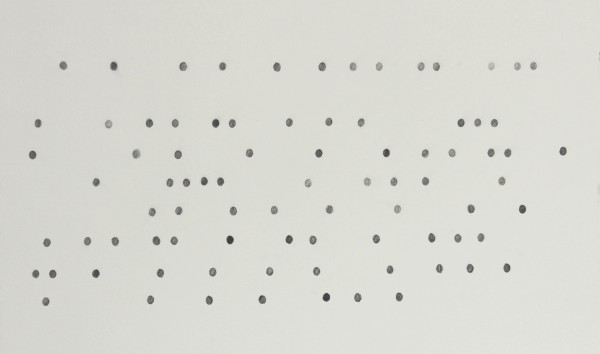
My 2009 project “26 Passports” will be on exhibit at Angel’s Gate Cultural Center in San Pedro, CA from February 9 – April 11, 2014. This is the first time this piece has been shown. More details below.
Gettin’ Off The Ground: Contemporary Stories from An American Community
curated by Isabelle Lutterodt
Opening Reception Sunday Feb. 9, 2-5pm
Angel’s Gate Cultural Center
3601 South Gaffey Street
San Pedro, California 90731
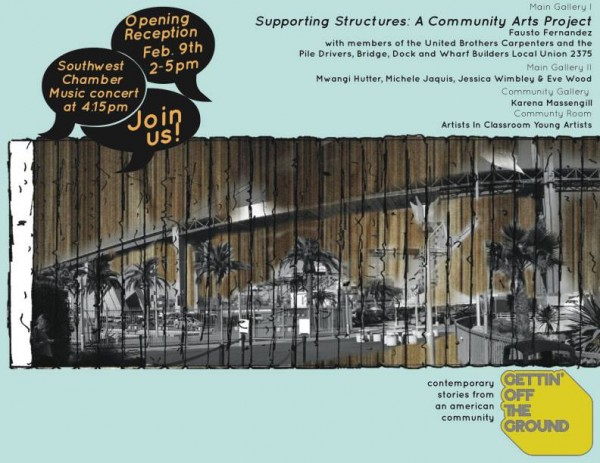
Angels Gate Cultural Center (AGCC) is thrilled to invite you to the launch of a new round of exhibitions that continue to explore how stories within the community shape the collective consciousness in San Pedro and South Bay area.
An Opening Reception for several new shows in the Galleries will be held on February 9, 2014 from 2:00pm-4:00pm. Chamber Concert at 4:15pm.
MAIN GALLERY I: Supporting Structures: A Community Arts Project – Fausto Fernandez in partnership with members of the Southwest Regional Council of Carpenters and the Pile Drivers, Bridge, Dock and Wharf Builders Local Union 2375
This project marks the beginning of a year-long partnership with the Union. Together we will explore the story of their members and families, the history of the labor movement in San Pedro and how this impacts the community at large. Los Angeles based artist Fausto Fernandez was selected by the Joe Baker, Executive Director of Palos Verdes Art Center, to work on the project.
MAIN GALLERY II: features artists: Mwangi Hutter, Michele Jaquis, Jessica Wimbley and Eve Wood
Work has been selected that continue to explore stories relevant to the local community. The work ranges from video to sculpture and explores issues of representation, identity and personal responsibility. Visitors will be able to tell their own story through interactive art stations in the gallery.
COMMUNITY GALLERY: Symbiosis – Karena Massengill with students from Cabrillo High School in Long Beach.
San Pedro based artist Karena Massengill will be showing work alongside her students work from Cabrillo High School in Long Beach, CA. The work represents the creative conversation that emerges between artist-teachers and students.
COMMUNITY ROOM: Artist-In-Classroom will showcase young artists from South Bay schools.
Features work by young artists from local and regional schools in the South Bay/Harbor region who have been instructed by Angels Gate Cultural Center’s Artists-Teachers
Following the reception, join Grammy Award-winning Southwest Chamber Music in Building H for a one-hour program featuring violinist Shalini Vijayan playing pieces from J.S.Bach, Kurt Rohde, Lera Auerbach, and Hyo-shin Na, and talking about classical and contemporary music.
This program is part of the Music Unwrapped series of free community concerts. These informal and interactive performances are designed to break down the barriers between musicians and audiences of all ages.
Angels Gate Cultural Center galleries are open to the public Monday through Friday from 11 a.m. to 5 p.m., and on the second Saturday of the month from 12 – 5pm. Admission is always free.
What you should know and be able to do
Sarah Rushford
October 25 – November 30, 2013
Opening Reception: Friday, October 25th — 6-9pm
Artist Reading and Screening: Saturday, November 2nd — 7-9pm
Sarah Rushford will read from her poetry manuscript and several short video works will be screened.
What you should know and be able to do (text voids), 2013, graphite on paper
The Hallway Gallery is excited to announce its next solo exhibition featuring the interdisciplinary work of Sarah Rushford. What you should know and be able to do will feature text art, works on paper, video, audio, and sculpture by Boston-based artist, Sarah Rushford.
Sarah earned her BFA from Hartford Art School in 1998 and MA in Media Studies from The New School in 2001. As a multimedia artist she is currently working in writing, video, and collage. She recently completed art and writing residencies at TAKT Kunstprojektraum in Berlin and Art Farm in Nebraska. She has exhibited in Boston, New York, Los Angeles, and Berlin.
I make art across diverse media and I use ordinary materials and objects like flour, talcum powder, children’s games, sewing needles, ice, pins, text. The processes performed on these are simple, and remain simple. Dots, lines, letters and rubbings are made, fabric is folded, the camera is fixed, objects are pressed onto paper, holes are poked. The almost over-simple gestures accrue a vulnerable, striking, beauty; a transcendence. My process is impatient, imprecise, inarticulate, playful, and I often feel foolish. When a project comes to fruition, I have a mastery of a strange skill. I am working to articulate this mastery that exists on a continuum with foolishness.
The works are that of noticing and invisibility; they are about the anomaly that the vivid interior self and the living argument of consciousness can be sharp and definite to the individual, yet invisible to the outside, to others, and to science.
The Hallway Gallery
66a South St
Jamaica Plain Ma 02130
thehallwayjp.com
Gallery hours:
Tuesday-Saturday 10am-6pm
Sunday 12-4pm
& by appointment
If you’d like to set up an interview with Sarah Rushford or schedule a private viewing of the exhibition, contact me at your convenience.
Sarah Rushford’s What you should know and be able to do
was featured in Artscope magazine’s weekly emailed exhibitions roundup:
in Jamaica Plain, Massachusetts October 25th through November 30th
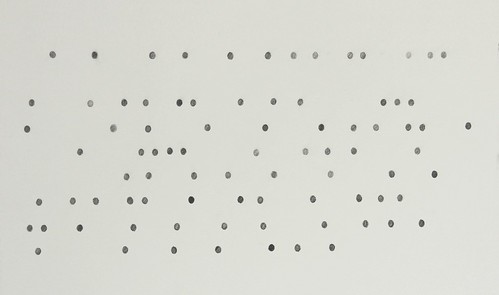
What you should know and be able to do (text voids) by Sarah Rushford, graphite on paper, 24″ x 16″.
Have you ever felt like you’re floating through whatever you’re doing at the moment? Perhaps it’s a craft, a skill, or a career. What’s important to note is that the floating isn’t a surrender or a sign of boredom; it’s a movement from control to subconsciousness, from instruction to intuition. Interdisciplinary artist Sarah Rushfordexperiences this exact sensation as she works on projects, allowing her to transcend the boundaries of craft and theory and focus solely on the simplicity of the process.What you should know and be able to do is Rushford‘s solo exhibition of text art, works on paper, audio, video and sculpture that come from a space between the living argument of consciousness and the vivid interior self. Of her process, Rushfordsays, “I have a deep trust in intuition. I know there is a thinking that is above my conscious thinking that comes through doing. To get at these higher connections that are made, miraculously, I have to be very busy with the ‘lower-level’ work, much of which is cast off when the final work is realized.” This creates final products of simplicity: materials like flour, sewing needles, ice and children’s games and techniques like rubbing, folding, fixing and pressing. The almost over-simplistic nature of her projects leaves us with a strikingly vulnerable beauty. “My process is impatient, imprecise, inarticulate, playful, and I often feel foolish,” Rushford says. “When a project comes to fruition, I have a mastery of a strange skill. I am working to articulate this mastery that exists on a continuum with foolishness.” The level of honesty and universality radiating from Rushford and her works is appealing to anyone of any background, any discipline. As a multimedia artist, Sarah Rushford is currently working in writing, video and collage. In 2010, she started Circadia, a web and print design company for artists, small businesses and non-profits. She is also a member of Rise Industries, a forum for exchange between artists and a starting point for interdisciplinary collaborative projects. What you should know and be able to doopens tomorrow, Friday, October 25th at Hallway Gallery with an opening reception from 6-9pm. The exhibition will run through Saturday, November 30thand will feature an Artist Talk/Screening on Saturday, November 2nd from 7-9pm.
You hold it in your mind all the time. Artists Talk and Closing Reception.
Saturday, September 24 · 2:00pm – 4:30pm
Art At 12
12 Farnsworth St
Boston, MA
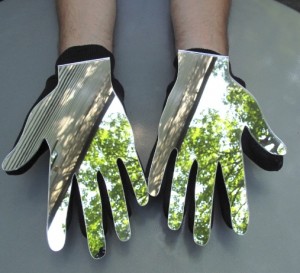
Join us for an artists talk about this exhibition of experimental work about physicality and perception. Artists: Michele Jaquis, Heidi Kayser, Jeremy J. Quinn, Sarah Rushford, Marguerite White, Tom Wojciechowski.
The exhibition includes projected and monitor based video, sculpture, drawing and photography that takes an experimental, scientific, or analytic approach to the investigation of the mysterious nature of somatic knowledge.
See the exhibition announcement and press release
www.fortpointarts.org for more info
Rise is excited to announce the opening of “You hold it in your mind all the time.” An exhibition about physicality and perception that includes multimedia works by Michele Jaquis, Jeremy J. Quinn and Sarah Rushford of Rise Industries as well as Boston artists Heidi Kayser, Marguerite White, and Tom Wojciechowski.
We would be so happy to see you at the opening on August 11 or the artist talk on Sept 24. Or stop in during gallery hours of course!
(Please note the change in the artist talk date from the printed postcard, which says Saturday Sept 15 )


You hold it in your mind all the time.
An exhibition of experimental work about physicality and perception.
August 11 – September 30, 2011
Michele Jaquis
Heidi Kayser
Jeremy J. Quinn
Sarah Rushford
Marguerite White
Tom Wojciechowski
Reception: Thursday August 11, 2011 5:00-8:00 pm
Artists Talk/Closing Reception: Saturday September 24 2:00pm
Art at 12
12 Farnsworth Sreet
Boston MA 02210
www.fortpointarts.org
617 423 1100
Art at 12 Gallery Hours
Mon-Fri 11am-6pm, Sat 11am-4pm, Sunday by chance
Art at 12 Gallery presents You hold it in your mind all the time, an exhibition of multidisciplinary work by Boston artists Heidi Kayser, Sarah Rushford, Marguerite White, and Tom Wojciechowski and Los Angeles artists Michele Jaquis and Jeremy J. Quinn. The show dates are August 11 – September 30, 2011, with an opening reception on August 11th and an artist talk and closing reception on September 24th. The exhibition includes projected and monitor based video, sculpture, drawing and photography that takes an experimental, scientific, or analytic approach to the investigation of the mysterious nature of somatic knowledge.
Informed by philosphy, narrative, and neurobiology, You hold it in your mind all the time expresses and questions the folded duality of the self; the notion that the body is our infinitely personal, private selfhood, and is also a physical object in the outside world. Art theorist Gabriele Brandstetter writes of this strange doubleness “The body is a being of two leaves; from one side a thing among things and otherwise what sees and touches them.”
Heidi Kayser’s sculpture Spanning the Rift is a suspension bridge made of eyeglasses which, Kayser states,“addresses the internally confounding problem of time and helps extend perception by closing the distance between looking back and looking forward.”
Michele Jaquis’s Until I Can Speak my Mind is a short film that was inspired by a recurring dream that both the artist and her twin sister have had in which the artist is chewing bubble gum which she then spits it into her hand, only to find in the next shot that the gum is still there and is getting bigger.
Jeremy Quinn’s What Holds Us Together is a video projection that depicts the Brooklyn Bridge with its middle section conspicuously missing, while the view into Manhattan (the World Trade Center towers missing) remains intact. Traffic seems to pass into and out of a charged void that separates the two sides of the bridge in this commentary on emptiness and separation.
Sarah Rushford’s Quickening is an interactive installation. Viewers reach into a box that contains a green apple and a live video feed of their hand is mixed with a recorded video of another hand touching the apple. Viewers report feeling a strange a ghostly presence as the two images mix.
Marguerite White’s Cargo Cult is a shadow theatre constructed with cut paper and simple light
projections. This surreal narrative is a reflection on the power of visual memory and the subjective nature of physical perception.
Also included are large scale abstract landscape photographs by Tom Wojciechowski, in which familiar objects—a hand, a landscape, set up a perceptual conundrum and create a space that can’t or shouldn’t exist.
You hold it in your mind all the time illuminates a diversity of multidisciplinary contemporary art practice to suggest that what may seem to be private, even mysterious somatic experiences are actually shared perceptions that might be articulated.
I participated in the Bumpkin Island Art Encampment 2011 with the Axiom Center for New and Experimental Media. Here is more about the work I created during the residency.
Common Names is a site specific sculpture made of approximately 150 beach stones wrapped in paper, and installed near a grove of sea grasses on the beach at Bumpkin Island. The paper was wet before applying to the stones, and as it dried in the sun it took on the contours and shape of the stones. After drying, I wrote a name on each rock in graphite. The names were a combination of common names, and names of people I know.
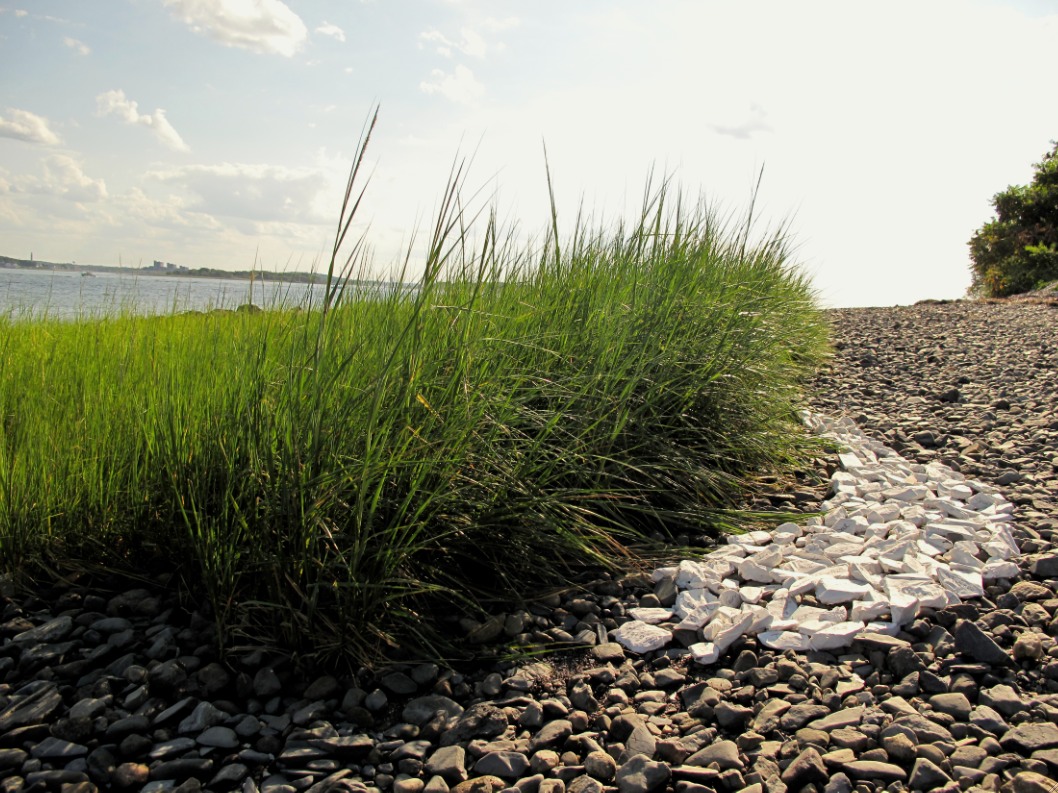
Common Names, site specific sculpture, 150 rocks, paper graphite

Common Names, site specific sculpture, 150 rocks, paper graphite

making Common Names
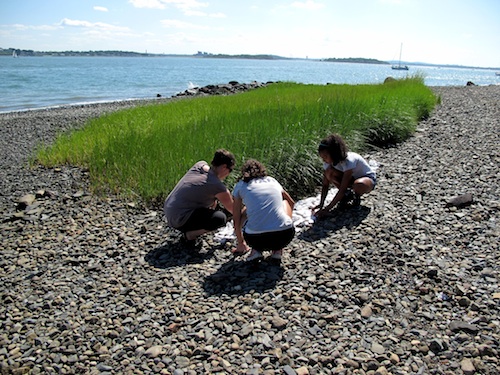
making Common Names
Volunteers helped wrap the rocks, and also helped to generate name ideas. The conversation about names and naming is an evokative, personal, specific one that even strangers can easily become engrossed in. Each name and each stone seems to be for one person, and for every person.
The stones with their names nestled at the edge of the sea grasses seem vulnerable and protected at once. They are visible from far away because of their color, but their shapes and contours match that of all the stones on the beach.

Common Names, site specific sculpture, 150 rocks, paper graphite
Common Names is about the strange dual sense of self that we have as human beings. On one hand we have a profound sense of individuality and private selfhood, and on the other hand, most of what we call our identity; our DNA, our bodies, our perception, our basic human needs, almost our entire identity, is shared with every member of humanity.
Verses is an ongoing work in which prose verses that I composed are written in a stylized text, on long paper banners, and applied to the ground in areas of the landscape that are intended as views or lookout points. The banners are tilted and appear like a subtitle to the view. The two texts that I applied at two key lookout points at Bumpkin Island are the following
“Everything will be fine, your struggle, and the fighting of your mind, the pitching motions of your experience.”
“The sky will take on a yellow cast, once this cast has grown into morning, let the light of that morning fall on your hands, keep them still until the light changes.”
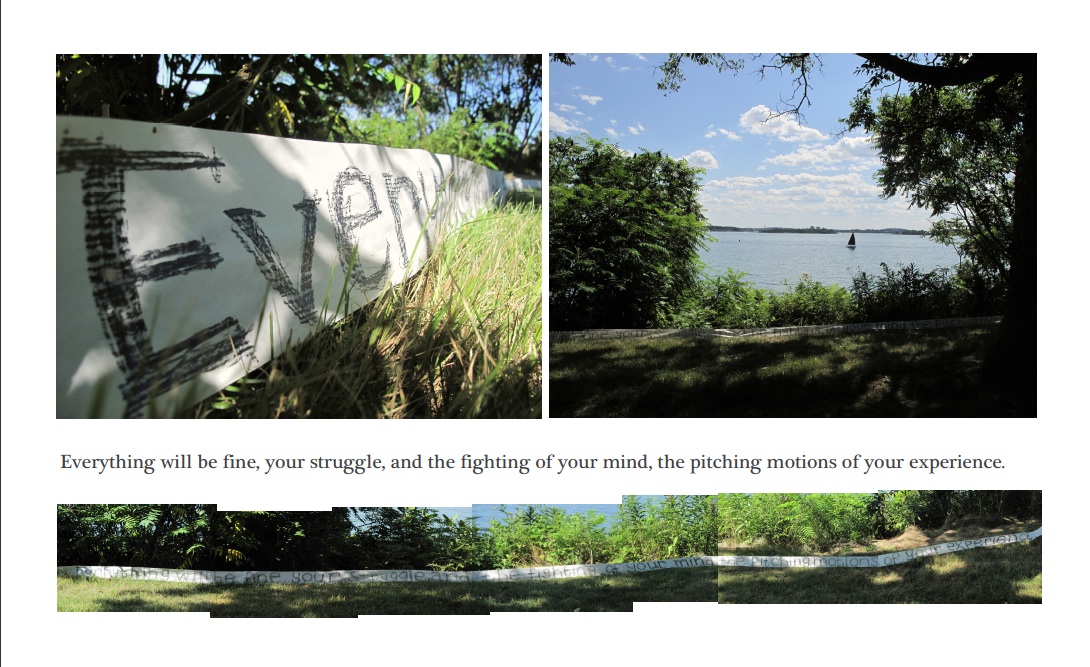
Verse 1 Text banner applied to landscape

Verse 2 Text banner applied to landscape
Verses shares something with Common Names. While the texts seem to talk directly to the individual reader, they also talk to every reader. I intend for them to touch the reader’s private sense of selfhood and also their sense of self as an archetype in a broad humanity. They are like bible verses in that way, speaking to the individual and the archetypal reader at once. But unlike Bible verses they ask the reader to rely on him or herself and on this world for strength and solace, instead of asking them to look outside of themself to God or to the idea of Heaven.
So I still haven’t had a chance to reflect on my time at ICI, mostly because I’ve been getting ready for my next exhibition: Debating Through the Arts. The exhibition is organized by Jerri Allyn and Inez Bush and opens this Saturday (6-10pm) at 18th Street Art Center in Santa Monica. Come see my multimedia installation, i Scream LA! made in collaboration with Beth Peterson and Trinidad Ruiz. It will evolve all summer as we’ll be collecting videotaped interviews with residents of LA’s diverse neighborhoods, in exchange for ice cream. Let us know if you want to be interviewed by our puppets. Come on… everyone loves puppets and wants ice cream in the summer!
posted by
Sarah on 2011.06.10, under
art,
culture,
education,
exhibition,
humor,
ICI Residency,
photo,
rise info,
Uncategorized,
writing
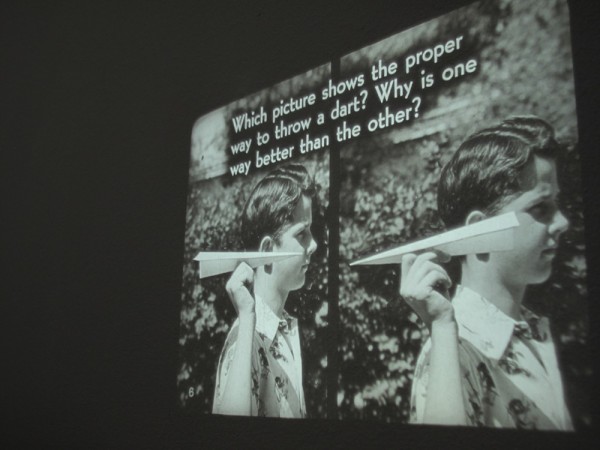
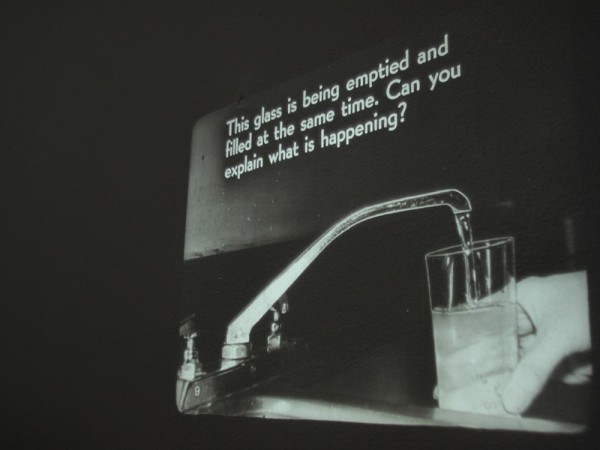
Here are a few more photos and info about what Rise Industries was up to on Day 6-7 of the ICI Residency. Today, Friday, is the final install day for the exhibition, and Jeremy, Michele, Mike, and John are still at ICI, but I’ve returned to Boston, and already miss it!
These two photos above, are from the filmstrip The Air About Us; a 1959 filmstrip for grammar school students, about a range of ideas relating to air and air pressure. The slides are beautifully photographed, oddly diagrammatic and some with the same awkward humor you see in those above. The filmstrip, which I watched without audio, has a wierd tonal contrast between pedagogy and poetry, science and spirituality. It’s an experimental text and image work in itself.
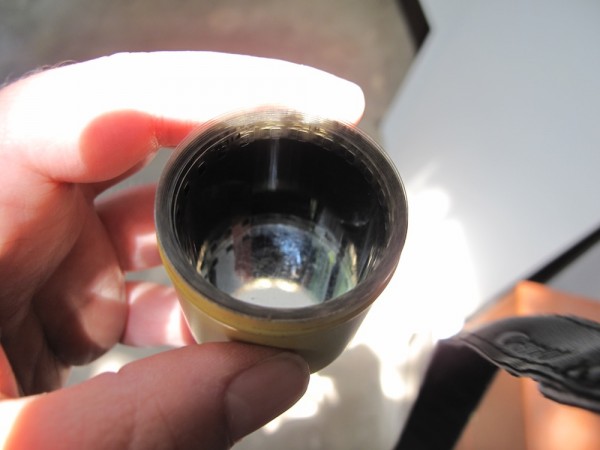
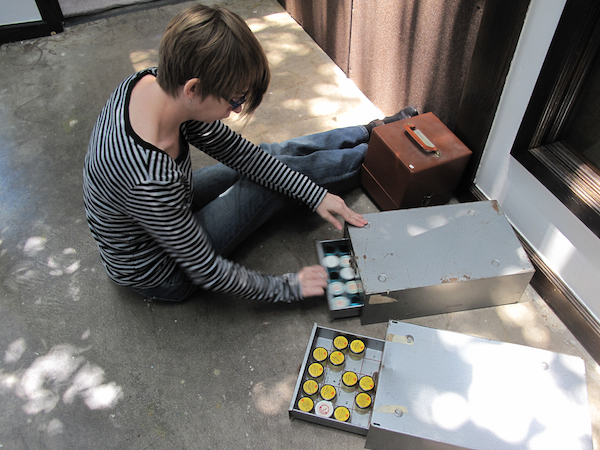
I discovered what I thought was the empty filmstrip canister on my first day at ICI. A photo of the title on top of the canister is featured in exhibition. But, because it’s such a short filmstrip, it was actually clinging so close to the sides of its canister that I really thought the canister was empty. The last day I was there, I happened to open the canister again and realized the film had been there all along…
The Air About Us , the phrase alone relates to the work we did during the residency. The air about us could be the representation of distance using two dimensions; the uncanny quality of our 3d stereographic portraits. The air about us could be the cultural distance that travel photography can put between the subject and photographer. Or, it could be about misrepresentations of sizes and distances of continents in global projection maps. It could also be about the contrast of closeness and distance we encounter in video chatting. Also, the air about us, is about us; Rise Industries. It’s about our personal relationships and histories and the roles we organically adopt within the collaborative, and challenges we face as we make art as a collaborative with members on opposite coasts and more than one continent. Working with Rise at ICI was a fantastic experience and I want to thank Rise and ICI, so very much!
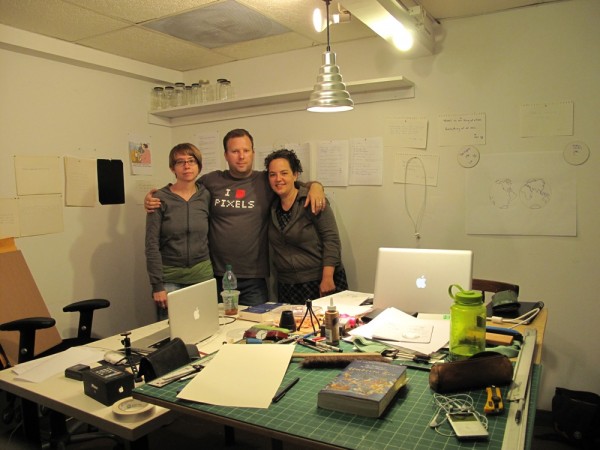
Michele Jaquis, Jeremy Quinn, and Sarah Rushford in the ICI Lab
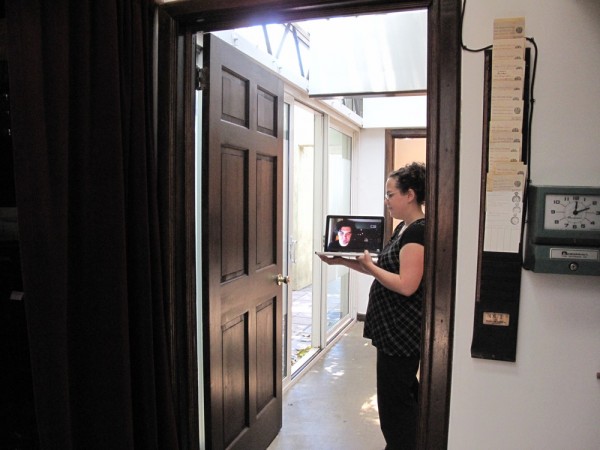
Me video chatting with Boris Margolin in Boston, showing him around ICI. Time clock and multi-time zone punch card piece at the right.
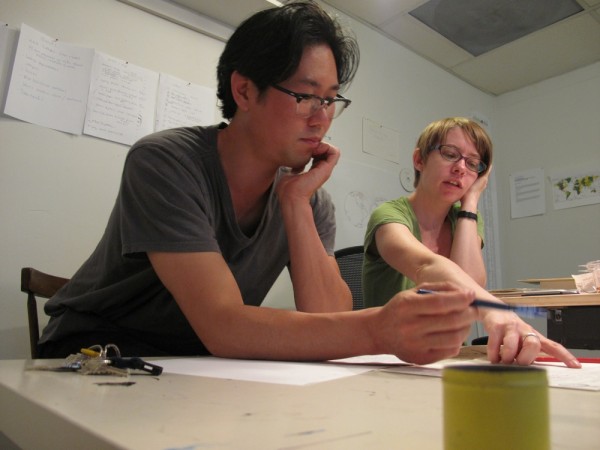
John Kim and Michele Jaquis discussing conversion techniques for Pacific Standard Time to Metric Standard Time.
While Jeremy and I were at our crit group meeting, Sarah spent the morning transcribing and re-transcribing text from The Island of the Day Before using carbon paper. The process allowed for an ever evolving abstraction to occur, similar in concept (although not aesthetically) to the degradation that occurs after a document has been photocopied too many times. Today I will attempt to translate the final abstraction into legible text again, without seeing the original sentence.
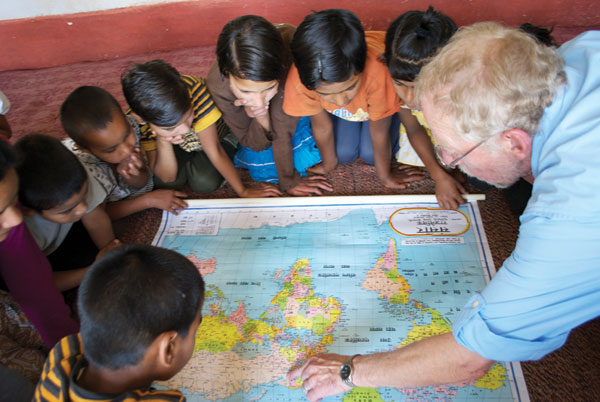
Right now Sarah and I are printing photos that we have shot over the last few days, as well as some that Nicole has sent us. Nicole’s will be juxtaposed with mine and some carbon copied text. This is one she shot of our father describing his travels between timezones to her students.
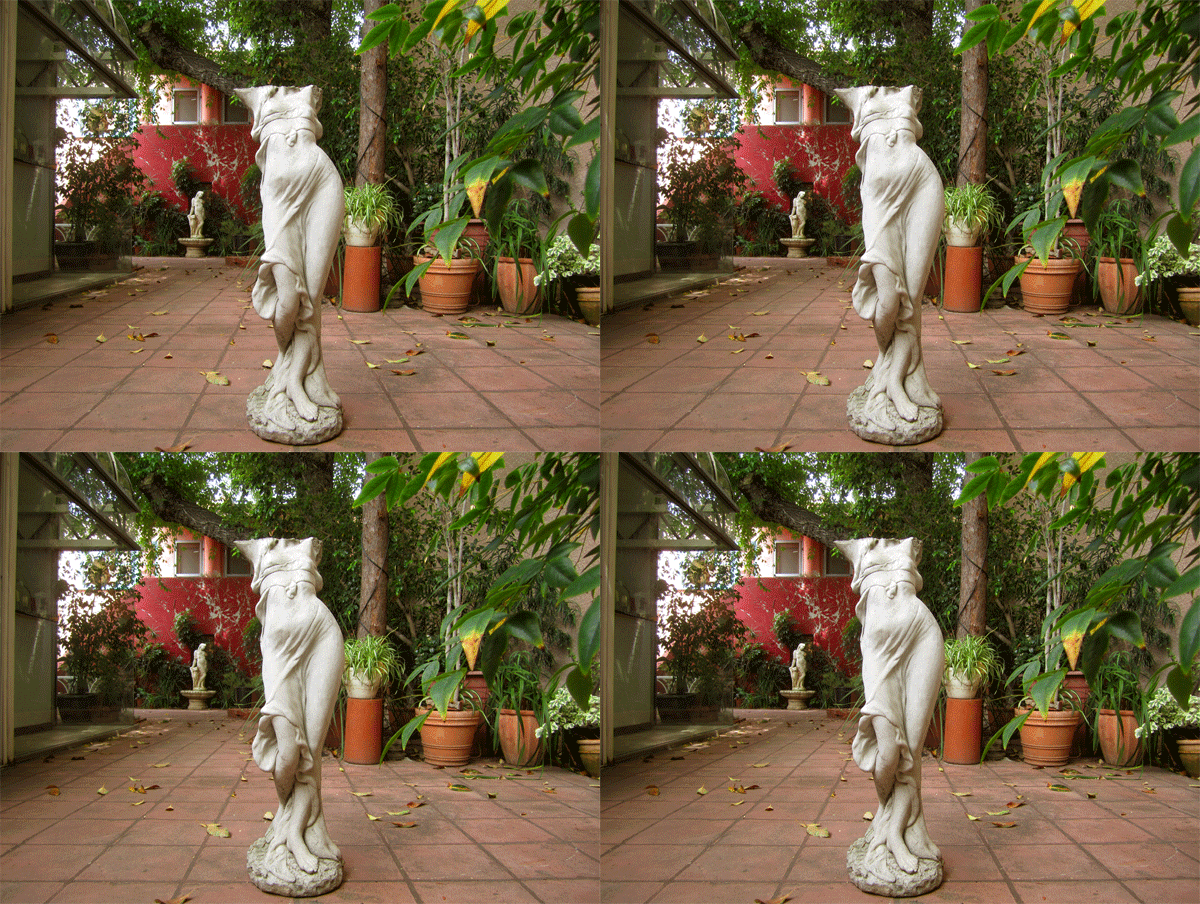
Above is the result of an experiment we carried out at ICI today. We made 3d sterographic portraits! This is one of a sculpture in the garden at ICI.
Jeremy named The Island of the Day Before by Umberto Eco as a book that is influential to the ideas we will work with during the residency. I read the book years ago, and decided to re-read it, beginning on my journey from Boston to LA. I’m struck by the richness of the text, and have been marking passages I plan to excerpt for work at ICI. The humor, and ideas of parallel experience emerge as I read. Jeremy, Michele and I are busy with the work of collaborating, unearthing an archive, making interdisciplinary work, and planning an exhibition, simultaneously, and I can’t speak for them, but I am glad to have this text at my side to ground my thoughts and ideas.
We’ve received virtual visitation in the form of art work from fellow Risers Nicole Jaquis and Tim Devin today! Nicole sent two very striking documentary photos of her father visiting Hardiwar India, where Nicole lives. We plan to pair a print of one of the photos, (a shot of Marty, Nicole and Michele’s father, jet-lagged and asleep ) with an excerpt from The Island of the Day Before.
Tim Devin’s work arrived in the mail this morning. It’s a project called BBC Broadsides. These are posters that represent statistical maps with information about Los Angeles demographics and water supply. They will be posted throughout the city. Photos of the posters in the city will be exhibited at the 10/10∆8 Exhibition. More on Tim’s project, another version of which he completed in Boston, can be found here.
This morning at ICI we looked at grammar school film strips on a Dukane film strip projector and decided on a particularly apt frame to include in the exhibition. The film strip, entitled Space Travel A.D. 2000, includes a frame that shows a drawing of a boy on the beach and the caption reads “We know that the world is round, but we seldom sense that it really is.” Michele looks through the film strip titles in their cases below.


 rss feed